MoonFire Chronicles
Your ultimate resource for mastering live virtual events. Dive into a treasure trove of tips, tricks, and tactics designed to empower entrepreneurs. Whether you're just starting or looking to elevate your game, these articles are to help guide you every step of the way. Join us on this journey and unlock the magic of unforgettable events!
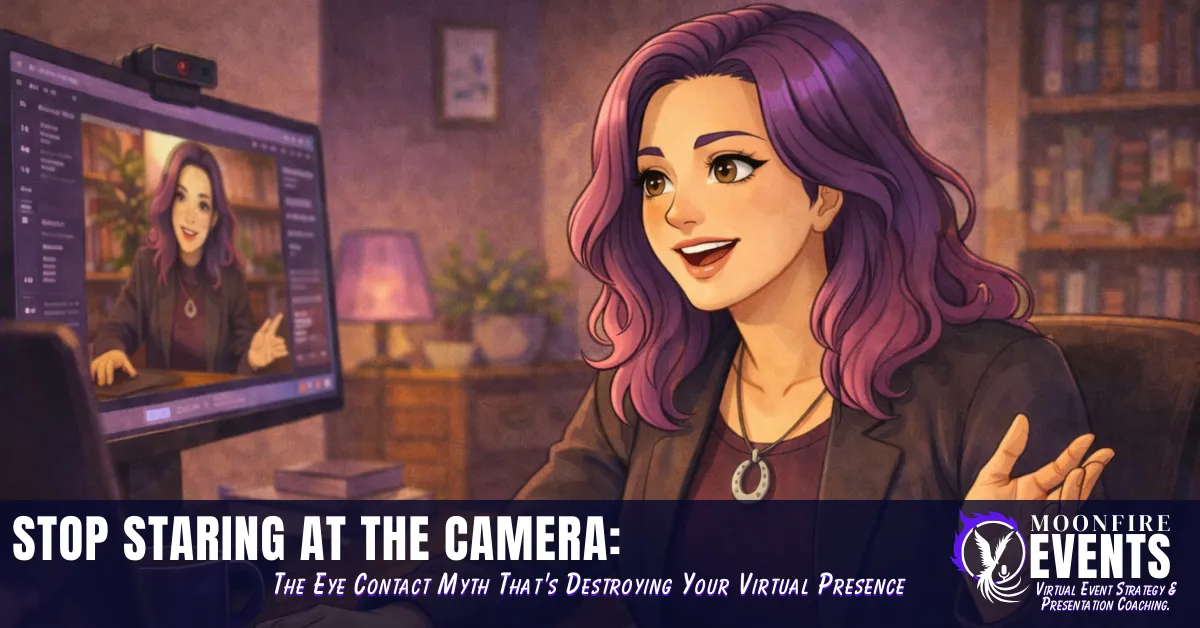
Stop Staring at the Camera: The Eye Contact Myth That's Destroying Your Virtual Presence
MoonFire Events | The Virtual Event Whisperer | On-Camera Presence & Performance
Imagine this: You're ten minutes into your virtual workshop. You've prepared. You know this material. And you're completely, mortifyingly blank.
Not because you forgot what you were going to say. Not because you're nervous. But because every single neuron available to you has been conscripted into one job: stare at the camera dot.
Your eyes are locked. Your face is doing the thing. You look, by every measurable standard, like a professional. And your brain has quietly left the building.
This is the camera eye contact myth in action - and if you've ever experienced it, you already know something is wrong with the advice. You just haven't had permission to say so out loud.
Here it is: Staring at your camera is not a presence skill. For many brains - especially neurodivergent ones - it's a presence killer. And the fact that every media trainer, presentation coach, and "look more professional on camera" article keeps repeating it doesn't make it true. It makes it a very well-distributed piece of bad advice.
In this post, we're going to break down where this rule actually came from, what it's costing you cognitively every time you comply with it, what the research says about eye contact and authentic connection, and - most importantly - what to do instead. Whether you've been white-knuckling your way through camera lock for years or you're just starting to name the thing that's been derailing your delivery, this one's for you.
Where the "Look at the Camera" Rule Actually Came From
Before you can reject a rule, it helps to understand who made it and why. The "maintain eye contact with the camera" directive did not emerge from research on virtual communication, neuroscience, or even audience psychology. It came from two very specific, very limited contexts: broadcast television and in-person public speaking training.
In television, camera eye contact was a technical workaround - a way for news anchors reading from teleprompters to simulate directly addressing a viewing audience. The camera was a proxy for the viewer. Looking into it was a production choice that created the appearance of connection in a one-way medium where no actual connection was possible.
In-person public speaking training took the eye contact principle from a different angle - the idea that holding someone's gaze signals confidence, engagement, and trustworthiness in a direct, face-to-face social context. That principle has legitimate grounding in in-person communication research, though even there, the "rules" are more nuanced than most coaches teach.
Neither of these contexts is a virtual event. Neither of them involves a presenter who is simultaneously hosting, producing, managing slide transitions, monitoring a chat feed, tracking time, and delivering content - all while being their own stage manager, tech support, and keynote speaker rolled into one.
The camera-eye-contact rule was never designed for the cognitive demands of virtual event hosting. It was borrowed, stripped of context, and handed to solopreneurs as though it were a universal law of professional communication.
It isn't. And you are allowed to say so.
The Cognitive Cost: What's Actually Happening in Your Brain
Here's what nobody in the "look at the camera" camp is telling you: eye contact - even simulated eye contact with a camera lens - activates cognitive load.
When your brain commits to maintaining a fixed visual focal point, it is allocating resources to that task. Resources that would otherwise be available for word retrieval, idea sequencing, expressive processing, and real-time thinking. This is not a willpower problem. It is not a confidence problem. It is a bandwidth problem, and it operates the same way regardless of whether you're neurotypical or neurodivergent - though the effect is often more pronounced for ND brains.
Research on eye contact and cognitive performance supports what many ND presenters have been experiencing their entire lives without language for it: forced eye contact competes directly with thinking. A 2016 study by Kajimura and Nomura, published in the journal Cognition, found that maintaining eye contact shares domain-general cognitive resources with verbal processing - meaning when eye contact demands are high and speaking demands are high, they compete. Your brain has to choose.
For ADHD brains, the demand to maintain performative camera lock can trigger a task interference effect - the gaze task competes directly with the content task, and one of them loses. For autistic brains, the cognitive and sensory weight of sustained eye contact (even with an object standing in for a person) can be significant enough to derail executive function entirely.
But here's the part that gets me fired up: this isn't new information. The cognitive cost of forced eye contact has been documented. The masking burden carried by ND communicators is well-established. And yet the presentation industry keeps selling camera eye-lock as the gold standard of professional delivery - to an audience that includes a significant percentage of people for whom that standard is actively harmful.
Masking - performing neurotypical behaviors at the expense of your own cognitive resources - has a measurable cost. It depletes working memory. It increases fatigue. It degrades the quality of the very performance it's supposed to enhance. When you force camera lock and your delivery suffers, that's not you failing at professionalism. That's masking doing exactly what masking does.
You don't have to keep paying that tax.
What Real Connection Looks Like on Camera (It's Not Eye Contact)
Here's the reframe that changes everything: your audience is not measuring the angle of your gaze. They are reading your face, your energy, and your engagement with ideas.
Think about the most compelling speakers you've watched - in any format. The ones who made you lean in, feel something, want to keep listening. Were they the ones whose eyes never left the camera? Or were they the ones who seemed genuinely alive in their material - whose faces shifted as they thought, whose eyes moved as they accessed memories and ideas, who occasionally looked away from you because something in their own mind had genuinely caught their attention?
Animated storytellers with natural, varied eye movement consistently read as more engaged and authentic than presenters performing camera lock. Not because audiences consciously notice the difference in gaze direction, but because the brain activity that drives natural eye movement is the same brain activity that drives compelling delivery. When you let your eyes move naturally, you're not breaking the connection - you're signaling that a real thinking process is happening in real time. And that is profoundly watchable.
The look-away moment when you're accessing a memory, working through an idea, finding the right word - that's not a credibility leak. That's visible thinking. It's the on-camera equivalent of the pause before a good answer. It signals depth. It signals presence. It signals that you are not reading from a script or performing a role, but actually thinking in front of your audience.
For neurodivergent communicators especially, natural eye movement is often more authentic than forced camera lock - and authenticity is the actual trust-builder. Not gaze direction. Not simulated eye contact with a piece of hardware. Authenticity. The sense that the person you're watching is genuinely, fully there.
Imagine if a solopreneur stopped forcing camera lock during her monthly workshop and instead let her eyes move naturally as she accessed ideas and told stories. Her participants, given no instruction to notice anything about her eye contact, later described her as "so much more real" and "easier to follow" than in previous sessions. Nothing else changed about her delivery. Just the removal of a rule that had been costing her her best thinking.
The camera didn't care. Her audience did - and what they cared about was getting her, not a performance of professionalism.
The REBEL Method Approach to Camera Presence
I want to be clear about something: what I'm offering you here isn't just a mindset shift or a permission slip (though it's both of those things). It's a framework. The REBEL Method is my proprietary approach to on-camera presence coaching - built specifically for neurodivergent brains, developed through thousands of hours of research, training, and hands-on education in virtual event production and presentation coaching, and designed to work with how ND brains actually process and communicate - not against it.
Most presentation coaching optimizes for looking confident. The REBEL Method optimizes for being resourced.
That's a fundamentally different goal, and it produces fundamentally different results.
When it comes to camera presence specifically, the REBEL Method approach starts by rejecting the premise that there is one correct way to look on camera that applies universally to all brains, all communication styles, and all delivery contexts. There isn't. There never was. The "correct way" was always just the neurotypical default - normalized through repetition, not validated through results.
What the REBEL Method does instead is help you identify how your brain actually communicates best - where it goes offline, what pulls it back into resource, what the specific interference patterns are for your particular wiring - and build your on-camera presence from that foundation, not from a set of performance rules designed for someone else's nervous system.
For camera anxiety and performative presence expectations specifically, this means replacing the "what should I look like" question with the "what does my brain need to stay online" question. It means treating camera lock not as a professional standard but as one option among many - one you use when it works for you and abandon without guilt when it doesn't.
If you've tried to fix your camera presence through traditional coaching and walked away feeling worse rather than better, that's not failure. That is a very useful signal that the approach needed to change, not you.
So where does that leave you?
Start with the DIY alternatives in the next section. Seriously - try the soft focus technique, reposition your camera, build your notes anchor, practice framing your thinking-out-loud moments. For some presenters, these adjustments alone create a significant shift and that's a complete win.
If you've already been working on this independently - experimenting, adjusting, trying to troubleshoot your own delivery - and your brain is still going offline under pressure, that's not a sign you're unfixable. That's a sign you'd benefit from a structured framework built specifically for how your brain works. The REBEL Method exists for exactly that moment: not to replace the work you've already done, but to help you get where you're trying to go faster, and with a significantly greater chance of actually getting there. Because that's what good coaching does. It compresses the timeline between where you are and where you want to be - and it removes the guesswork that solo troubleshooting leaves behind.
Practical Alternatives: What to Do Instead
Let's get tactical. Because permission is essential, but permission without tools just leaves you staring at a camera with guilt instead of obligation.
The soft focus approach. Instead of locking onto the camera lens, soften your gaze toward the camera area - the general zone around and just above your camera. This creates the visual impression of forward-facing engagement for your audience while releasing the cognitive grip of fixed-point focal attention. It's a small physical adjustment with a disproportionately large impact on how resourced your brain feels.
Use your notes as a legitimate visual anchor. Having your outline or key points visible - whether on a second monitor, a printed sheet just below your camera, or in a notes panel - gives your eyes somewhere purposeful to go when you need it. This is not cheating. This is smart environmental design. Your audience sees a presenter who is organized and prepared. Your brain gets to stop white-knuckling the gaze point.
Frame your thinking-out-loud moments. Before you look away to access an idea, give your audience a micro-signal: "Let me think about this for a second" or "Here's what I keep coming back to when I work through this with clients- " and then look wherever your brain needs to go. The verbal frame makes the visual movement intentional rather than accidental. It reads as thoughtful. Your audience stays with you.
Camera positioning matters more than camera lock. If your camera is positioned awkwardly - too far below eye level, off to one side, or in your peripheral vision - the physical act of "looking at it" is pulling your gaze in an unnatural direction that adds to the cognitive load. A camera positioned at eye level or slightly above, directly in front of you, dramatically reduces the effort of natural forward-facing engagement. This adjustment costs nothing and changes the entire physical experience of presenting on camera.
The honest decision framework: Try camera lock if it genuinely works for your delivery and your brain stays online. Abandon it without hesitation if your word-finding slows, your thinking goes flat, or you feel yourself performing rather than communicating. Your delivery quality is the measurement that matters - not compliance with a rule someone borrowed from broadcast television.
The Bottom Line
The most magnetic virtual presenters are not the ones staring hardest at the camera.
They're the ones whose brains are fully online - thinking, accessing, connecting with their material, and communicating from a place of genuine engagement. They have natural eye movement because natural eye movement is what happens when a brain is actually working. They look away sometimes because looking away is what thinking looks like. They're compelling not because they're performing connection but because they're experiencing it.
After analyzing and being involved in 50+ virtual events and spending thousands of hours in research, training, and education in virtual event production and on-camera presence, one pattern shows up without exception: animated, present, brain-engaged delivery outperforms technically "correct" performance theater every single time. Your audience can feel the difference, even when they can't name it.
You were taught a rule that was never designed for your brain, your context, or your communication style. You tried to follow it. It cost you. And now you know it doesn't have to.
Stop performing eye contact. Start presenting from genuine presence.
Your audience will thank you for it.
Ready to stop performing and start presenting?
Book a free 30 minutes and let's talk
Let's figure out what's actually getting in your way on camera.
Claudine Land is The Virtual Event Whisperer - founder of MoonFire Events and creator of the REBEL Method and Live Event Lifecycle. She has analyzed and been involved in 50+ virtual events and spent thousands of hours in training, research, and education in virtual event production, on-camera presence, and audience engagement. She helps solopreneurs run professional, brain-friendly virtual events without corporate budgets or production teams.

© 2025 MoonFire Events | Forge connections. Fuel growth. Own your stage.
Follow: LinkedIn | Instagram | YouTube | TikTok | Facebook