MoonFire Chronicles
Your ultimate resource for mastering live virtual events. Dive into a treasure trove of tips, tricks, and tactics designed to empower entrepreneurs. Whether you're just starting or looking to elevate your game, these articles are to help guide you every step of the way. Join us on this journey and unlock the magic of unforgettable events!
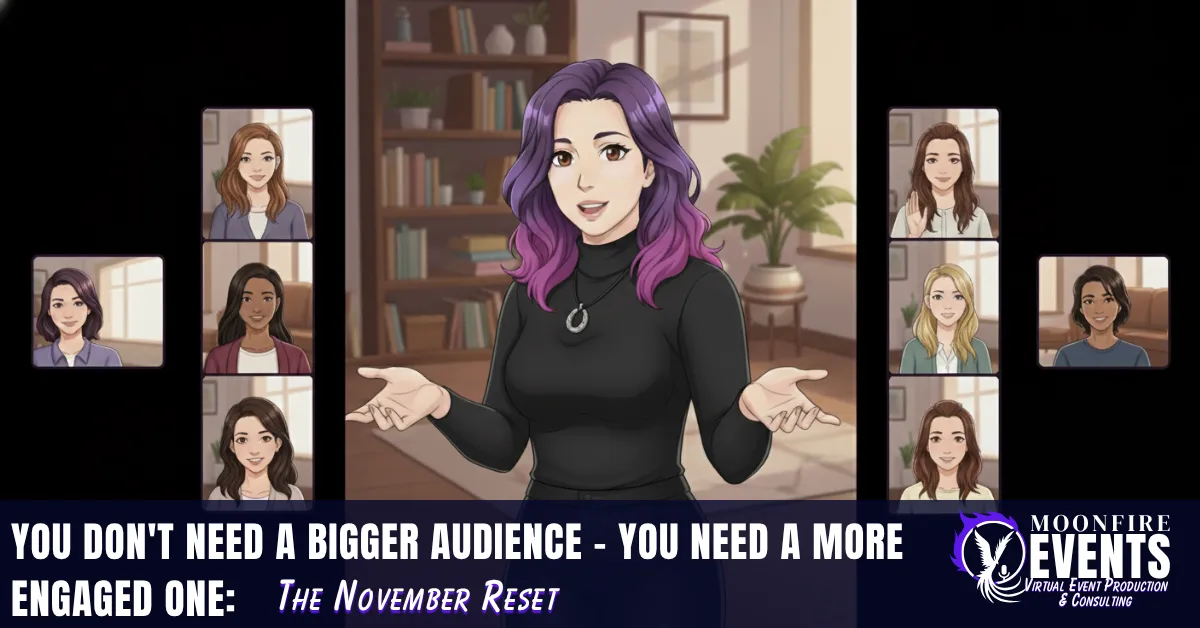
You Don't Need a Bigger Audience
You Need a More Engaged One: The November Reset
You're staring at your Q4 event registration numbers and that familiar panic sets in: "Not enough people signed up." So you do what everyone does - you push harder on promotion, expand your outreach, post more frantically, and convince yourself that if you just get MORE people registered, the event will be successful. Here's the truth nobody wants to hear: You're solving the wrong problem.
The "bigger audience" obsession is killing your events - and your energy. Every additional registrant adds cognitive load: more emails to manage, more tech accommodations, more potential for things to go wrong, more people to keep engaged. For ND brains already managing Q4 depletion, chasing massive attendance numbers isn't ambitious - it's self-sabotage. Meanwhile, intimate events with highly engaged audiences convert better, create stronger testimonials, require less management overhead, and actually feel good to host.
What if November was your reset month? What if instead of scrambling for bigger numbers, you designed Q4 events around deep engagement with the right people? You'd stop exhausting yourself promoting to audiences who'll never show up. You'd stop managing registration lists that make your brain hurt. You'd start having events that feel like conversations with people who actually want to be there - and who become clients, collaborators, and advocates.
This article will show you why smaller, engaged audiences outperform large, passive ones every time - and give you the framework to redesign your Q4 events around quality connections instead of vanity metrics.
The Lie We've Been Sold: Why "Scale" Became the Only Success Metric
Let's talk about where this obsession with massive audiences actually came from. The online business world worships big numbers - 10K followers, 500 registrants, sold-out webinars with hundreds of attendees. Scroll through any business coach's feed and you'll see screenshots of registration numbers, attendance metrics, and "reach" statistics like they're the only measures of success that matter.
Here's what nobody mentions: This metric obsession comes from a specific business model - high-volume, low-touch funnels designed to convert 1-3% of massive audiences. It's the model that works when you're selling $27 digital products to strangers who'll never interact with you personally. It's built for scale because scale is the only way that math works.
But that's not your business model. You're not running a digital product empire. You're a service-based entrepreneur, a coach, a consultant, a speaker who builds relationships and transforms lives through direct interaction. You're trying to apply someone else's success metrics to a completely different business architecture - and it's breaking your brain.
For ND brains, this matters even more. Every additional registrant isn't just a number on a spreadsheet - it's cognitive load. More names to track, more emails flooding your inbox, more tech variables to manage, more questions to field, more potential points of failure. When you're already managing executive function challenges, sensory processing, and the energy cost of masking, adding unnecessary scale complexity isn't growth - it's a recipe for shutdown.
Let's look at what actually happens when you chase big audiences:
Your conversion rate drops. Bigger audiences feel impersonal. People don't feel seen, don't feel special, don't build trust. They consume your content and ghost. Studies on virtual event engagement show that conversion rates decrease as audience size increases - intimacy builds trust, and trust drives sales.
Your tech gets complicated. Twenty people on a Google Meet? Easy. Two hundred people? Now you need advanced platforms, breakout room coordination, chat moderation, backup moderators, and contingency plans for when it all inevitably glitches.
Your energy gets depleted. You can't be authentically present with 200 people the way you can with 20. You start performing instead of connecting. You mask harder. You come away exhausted instead of energized, even if the event "went well."
Your follow-up becomes impossible. You know you should personally reach out to attendees. You know you should reference specific moments from the event in your follow-up. But with hundreds of people? It's unmanageable, so you send generic emails - and your conversion opportunity evaporates.
Permission slip: You're allowed to stop competing with people running different business models. Their 500-person webinar success doesn't mean you failed by hosting 30 people. They're playing a different game with different rules. You don't have to play it.
Here's the rebel action that changes everything: Look at your highest-converting event ever. How many people attended? I'll bet money it wasn't your biggest event. I'll bet it was the one where you actually knew participants' names, where the chat felt like a conversation instead of a feed, where you could respond to real questions in real time.
That's not a coincidence. That's data.
What Engagement Actually Means (And Why Most Events Fake It)
Let's get real about engagement. It's become a buzzword that means absolutely nothing in most contexts. Launch a poll every 10 minutes? That's not engagement - that's compliance training. Get chat messages saying "great info!" and "thanks for sharing"? That's not engagement - that's performative participation so people feel like they showed up properly.
Real engagement is something else entirely. Real engagement is when attendees are thinking differently, making unexpected connections, asking questions they didn't know they had, challenging assumptions, and planning to take action. Real engagement shows up in the post-event follow-up when someone emails you with "I've been thinking about what you said..." or "This completely changed how I approach..."
Here's the problem: Most "best practice" engagement tactics actively prevent real engagement from happening.
When you're frantically launching polls, managing breakout rooms, monitoring chat, prompting responses, and keeping everything moving on schedule, you're not creating space for depth. You're creating a production - and productions require the audience to stay in their seats and follow along. There's no room for the messy, non-linear, associative thinking that leads to actual breakthroughs.
For ND presenters, this is especially brutal. You're being told to maintain constant stimulation, manage multiple channels simultaneously, keep energy artificially high, and never let a moment of silence happen. That's not working with your brain - that's performing neurotypical expectations of what "engaging" looks like.
Meanwhile, true engagement requires psychological safety. People need to feel safe enough to ask the "stupid" question, admit they're confused, share a real struggle, or challenge what you're saying. That psychological safety is nearly impossible to create in massive audiences where everyone's worried about looking foolish in front of hundreds of strangers.
But in a room of 15-25 people? Suddenly it's possible. People see the same names showing up in chat. They start to recognize voices. The presenter can actually respond to individuals by name. Someone asks a vulnerable question and others say "oh thank god, I was wondering that too." That's engagement.
Here's how to design for real engagement instead of faking it:
Design for depth, not breadth. Instead of covering 47 tactics in 60 minutes, go deep on 3. Allow time for questions, application, discussion. Let people think.
Create actual space for thinking. This is the most radical thing you can do: build in quiet moments. "Take 60 seconds and think about how this applies to your situation." It feels awkward to you. It's gold for your audience.
Invite vulnerability and real questions. Small audiences make this possible. "What's the thing you're actually struggling with here?" beats "Drop a 👍 in the chat if you found this helpful" every single time.
Measure engagement by post-event action. Did they implement something? Email you with insights? Book a call? Refer someone to you? That's engagement. Chat activity during the event is just... chat activity.
Permission slip: Stop using engagement tactics that make YOU feel performative. If the "best practice" drains you, it's probably draining your audience too. The most engaged events I've ever hosted were the ones where I stopped trying to be engaging and just had a real conversation.
Rebel action: Pick ONE engagement element for your next event. Just one. Maybe it's a really good opening question. Maybe it's a mid-point application exercise. Maybe it's a closing commitment share. Make it meaningful instead of making it constant. Watch what happens when you give people space to actually engage instead of constantly prompting them to perform engagement.
The Cognitive Load Tax: Why Big Audiences Cost Your Brain More Than You Think
Let's talk about what big audiences actually cost you - not in money, but in cognitive resources. Because here's what the "scale your events" crowd never mentions: every additional registrant isn't just a number on your dashboard. It's a cognitive load your brain has to process, track, and manage.
Twenty-five registrants means 25 confirmation emails, 25 names to potentially remember, 25 people to track attendance for, 25 follow-up sequences to manage. That's manageable. Your working memory can handle it. Your executive function can track it without breaking.
Two hundred and fifty registrants means 250 confirmation emails flooding your inbox, 250 names you'll never remember, 250 tech variables (someone's audio will fail, someone's video won't work, someone will need special accommodations), 250 potential questions, 250 follow-up sequences you'll never personalize. That's not 10x the load - it's exponentially more complex.
For ND brains, this compounds fast. You're already managing:
Executive function challenges around time, organization, and task initiation
Working memory limitations that make tracking multiple threads difficult
Sensory processing that gets overwhelmed by too much simultaneous input
The energy cost of masking to appear "professional" and "put together"
Adding massive scale to that existing load isn't ambitious growth - it's asking your nervous system to do something it's neurologically not wired to sustain.
Here's what actually happens when you host events beyond your cognitive capacity:
You stop being present. You can't track chat, manage speakers, watch for tech issues, stay on schedule, AND remain authentically present with your content. So you dissociate. You start performing "event host" instead of actually being there. Your audience feels it.
You mask harder. With 20 people, you might be able to show up authentically - stumble over words, laugh at yourself, admit when you don't know something. With 200 people, the stakes feel higher, so you perform harder. The masking hangover after the event lasts for days.
Your tech complexity multiplies. Small events can run on simple platforms with minimal backup plans. Large events require advanced features, multiple moderators, backup systems, contingency protocols. Every additional layer is another thing that can fail - and another thing your brain has to track.
Post-event follow-up becomes impossible. You know personalized follow-up converts better. But with hundreds of attendees, there's no way to personalize effectively. So you send generic emails, lose conversion opportunities, and feel guilty about it - adding emotional load on top of cognitive load.
The recovery time extends. A well-sized event might leave you energized, or maybe needing a few hours to decompress. An event that exceeded your capacity leaves you completely depleted for 2-3 days minimum. You can't work, can't think, can't make decisions. That's not the price of success - that's the cost of ignoring your capacity data.
Here's how to work with your cognitive capacity instead of against it:
Calculate your "capacity number." Look at past events. At what audience size did you still feel fully present, energized, and capable? That's your capacity number. It might be 15. It might be 40. It's probably not 200. Honor it.
Design event formats that match your executive function reality. If managing breakout rooms makes your brain hurt, don't use breakout rooms. If live Q&A with the chat flying by overwhelms you, collect questions in advance. Match the format to your brain, not to what everyone says you "should" do.
Build in buffer time that scales with audience size. Bigger audiences need more buffer - for tech issues, for late starts, for handling unexpected questions. If you're not building that buffer in, you're setting yourself up for constant stress.
Choose platforms and structures that reduce management overhead. Google Meet with 20 people requires way less management than Zoom with 200. Simple slides you control require less cognitive load than complex tech integrations. Reduce the moving parts.
Permission slip: Your capacity is not a character flaw. It's data. Use it to design sustainable events instead of constantly recovering from ambitious ones. The most successful event producers aren't the ones hosting the biggest events - they're the ones hosting consistently without burning out.
Rebel action: Cut your next event's target attendance by 30-50%. Just try it. Notice what becomes possible when you're not managing scale. Notice how much energy you have during the event. Notice how your follow-up feels. That's the data you need.
The Intimacy Advantage: Why Smaller Events Convert Better (And Feel Better To Host)
Here's the conversion data nobody wants to talk about: small events dramatically outperform large events when it comes to turning attendees into clients. And it's not even close.
In my last year of hosting various event sizes, here's what the numbers looked like:
200-person webinar: 2% became clients (4 people)
50-person workshop: 8% became clients (4 people)
15-person intensive: 40% became clients (6 people)
Same amount of effort to plan and host. Dramatically different outcomes. The intimate event converted at 20 times the rate of the massive webinar - and generated more actual revenue because I could charge appropriately for the boutique experience.
This isn't an anomaly. This is how trust and conversion actually work.
People don't buy from people they've watched perform in a crowd of hundreds. They buy from people they feel actually see them, understand their specific situation, and can help with their particular problem. Intimacy creates the conditions where that kind of trust can develop.
Here's what becomes possible in small events that's impossible at scale:
Psychological safety. In a room of 15-20 people, someone can ask a "dumb" question without feeling like hundreds of people are judging them. Others jump in with "I was wondering that too!" Vulnerability becomes possible. That vulnerability creates connection. Connection creates trust. Trust drives sales.
Personalized value. You can address specific attendee needs in real time. Someone mentions a particular challenge - you can pivot your content to address it, share a specific resource, offer a relevant example. Your audience feels like the event was designed for them personally. Because in that moment, it was.
Memorable interactions. Nobody remembers being one of 500 people in a webinar. They do remember being one of 20 people in a conversation where the presenter knew their name, referenced their specific question later, and followed up afterward with a personalized note about something they discussed.
Real relationship building. Small events allow attendees to connect with each other, not just consume content from you. They start recognizing names in chat, responding to each other's questions, and building a mini-community. Those peer connections increase event value and create organic referrals.
The "I'm special" factor. Humans want to feel special. Small events deliver that. Limited spots create scarcity and exclusivity. Personal attention creates value. Being part of something intimate instead of something massive makes people feel chosen. That feeling translates directly into conversion and advocacy.
Here's how to leverage the intimacy advantage:
Cap registration intentionally. Don't cap it when you hit your "oh god this is too many people" point. Cap it at your strategic sweet spot. Market the cap as a feature, not a limitation: "Limited to 20 participants for personalized attention and deep engagement."
Use participant names throughout. "As Sarah mentioned earlier..." or "This builds on the question Jake asked..." People perk up when they hear their name. They feel seen. They stay engaged. And they remember you afterward.
Create moments for individual contribution. Not just "drop your answer in chat" participation, but actual individual moments. Quick round-robin shares, spotlight questions, brief case study discussions. Make people feel like active participants, not passive consumers.
Design follow-up that references specific moments. "I loved your question about X during the event" or "I've been thinking about the challenge you shared about Y." This is only possible when you actually had few enough attendees to remember these moments. That personalization converts.
Permission slip: You don't have to prove your worth by filling massive virtual rooms. You prove it by changing lives - and that happens in conversations, not crowds. The coaches and consultants making the most money aren't running the biggest events. They're running the right-sized events consistently.
Rebel action: Create a "boutique event" experience for your next Q4 event. Cap it at 20-25 people. Charge accordingly - your pricing should reflect the intimate, personalized experience. Design for depth, interaction, and relationship. Then watch what happens to your conversion rate.
The November Reset: Redesigning Q4 Events Around Engagement, Not Scale
November is your permission slip to completely redesign your event strategy. Not in January when everyone's doing "new year, new you" planning. Right now. Because you still have Q4 events coming, you're already feeling the strain of the current approach, and you have just enough time to pivot before year-end.
Here's the framework I use - and teach my clients - for resetting event strategy around engagement instead of scale:
Step 1: Audit Past Events
Pull up your data from the last 6-12 months of events:
Attendance vs. conversion:
Which events had the highest conversion rate (attendees to clients)? What was the audience size? I guarantee it's not your biggest event.
Energy expenditure vs. revenue:
Which events generated the most revenue relative to the energy you spent? Include prep time, hosting time, and recovery time in your calculation. The 200-person webinar that wiped you out for 3 days might have generated less revenue per hour of your life than the 25-person workshop you hosted easily.
Feedback quality correlated with event size:
Look at your testimonials and post-event feedback. The most valuable testimonials - the specific ones that reference transformation, the ones potential clients actually believe - where did they come from? Probably your smaller events where people felt personally impacted.
Write down what the data actually shows. Not what you wish it showed. Not what business gurus say it should show. What your real numbers reveal about what's working.
Step 2: Identify Your Sweet Spot
Based on your audit, answer these questions honestly:
What audience size allows you to stay fully present?
At what number do you stop performing and start actually connecting? For some people it's 15. For others it's 40. There's no right answer except your truth.
What format matches your cognitive strengths?
Are you better at structured presentations or flowing conversation? Do you thrive with live Q&A or prefer questions submitted in advance? Does managing breakout rooms energize or deplete you? Choose formats that work with your brain.
What tech setup can you manage without overwhelm?
Simple platform you know well? Or a complex platform with features you'll stress about? Slides you control or interactive elements you'll fumble? Reduce the cognitive load of tech management.
What follow-up sequence is actually sustainable?
Can you personally reach out to 50 people? Or is 20 your realistic limit for personalized follow-up? Design for what you'll actually do, not what you aspirationally hope you'll do.
Your sweet spot is where these answers intersect. That's your event design target.
Step 3: Redesign Q4 Events
Now take your remaining Q4 events and redesign them around your sweet spot:
Cap registration at your capacity number.
Market it as intentional: "Limited to [X] participants for personalized attention." Early bird pricing for the first 10-15 spots creates urgency without scale pressure.
Choose depth over breadth for content.
Cut your content plan in half. Go twice as deep on what remains. Build in space for questions, application, and discussion. Your audience will get more value from less content covered deeply than more content skimmed superficially.
Build in actual space, not just content.
Silence is okay. Thinking time is valuable. Pauses for reflection create more impact than wall-to-wall content. Trust the space.
Plan intimate follow-up sequences.
Design follow-up you can actually personalize. If that means fewer emails to more people instead of generic sequences to hundreds, that's the right trade-off.
Step 4: Reframe Success Metrics
Stop measuring what doesn't matter. Start measuring what does.
What to measure:
Conversion rate (attendees → clients)
Testimonial quality (specific, believable, transformation-focused)
Referral generation (did attendees send others to you?)
Your energy level post-event (energized, neutral, or depleted?)
Revenue per attendee (not total revenue - revenue efficiency)
What to stop measuring:
Total registrants (vanity metric)
Social media reach (doesn't correlate with sales)
"Engagement" clicks during event (performative participation)
How your numbers compare to other people's numbers (irrelevant)
Judge your events by whether they create sustainable business growth and whether you can keep hosting them without burning out. Those are the only metrics that matter.
Permission slip: You can completely redesign your event model in November. You don't have to keep doing what's not working just because you said you would. You don't owe anyone massive audiences. You're allowed to pivot toward what actually works for your brain and your business.
Rebel action: Pick one Q4 event and redesign it around engagement, not scale. Cut the target attendance. Increase the depth. Charge more to reflect the intimate value. Make it boutique. Make it manageable. Then notice how it feels to host an event that doesn't require three days of recovery afterward.
Your Audience Doesn't Need To Be Bigger - It Needs To Be More Engaged
Let's recap what we've covered, because this matters:
The "bigger is better" lie is killing your events. Scale adds cognitive load, reduces conversion, and exhausts ND brains. It's not ambitious - it's unsustainable. You're trying to apply someone else's business model to your life, and it's not working.
Real engagement requires intimacy. You can't create psychological safety, genuine conversation, or memorable experiences with hundreds of people. You can with 15-30. The data proves it - smaller events convert at dramatically higher rates.
Your cognitive capacity is design intelligence. It's not a limitation to overcome. It's data about what's sustainable. Use it to create right-sized events instead of constantly recovering from too-big ones.
November is your reset moment. You have time right now to audit what's worked, identify your sweet spot, and redesign Q4 events around engagement instead of ego metrics. You don't have to wait until January to change everything.
Here's what becomes possible when you stop chasing scale:
Events that feel like conversations instead of performances. Audiences who become clients because they felt actually seen. Follow-up that's manageable because you're not drowning in hundreds of names. Q4 events that energize instead of deplete. A business model that works WITH your neurology, not against it. Conversion rates that actually reflect the value you provide.
This is not about doing less. This is about doing what actually works.
You don't need permission to stop competing in the "biggest audience" game. But if you did: Permission granted.
Stop designing events to impress other entrepreneurs with your reach numbers. Start designing events that create transformation for the right people - and that you can host without destroying yourself in the process.
Cap your registration at your capacity. Create experiences people remember instead of crowds you can't manage. Charge appropriately for intimate, personalized value. Build a sustainable event strategy that doesn't require you to perform at a scale you don't need.
You don't need a bigger audience. You need a more engaged one.
And November is exactly the right time to make that shift.
Ready to design sustainable virtual events that actually convert? Let's connect on LinkedIn

© 2025 MoonFire Events | Forge connections. Fuel growth. Own your stage.
Follow: LinkedIn | Instagram | YouTube | TikTok | Facebook