MoonFire Chronicles
Your ultimate resource for mastering live virtual events. Dive into a treasure trove of tips, tricks, and tactics designed to empower entrepreneurs. Whether you're just starting or looking to elevate your game, these articles are to help guide you every step of the way. Join us on this journey and unlock the magic of unforgettable events!
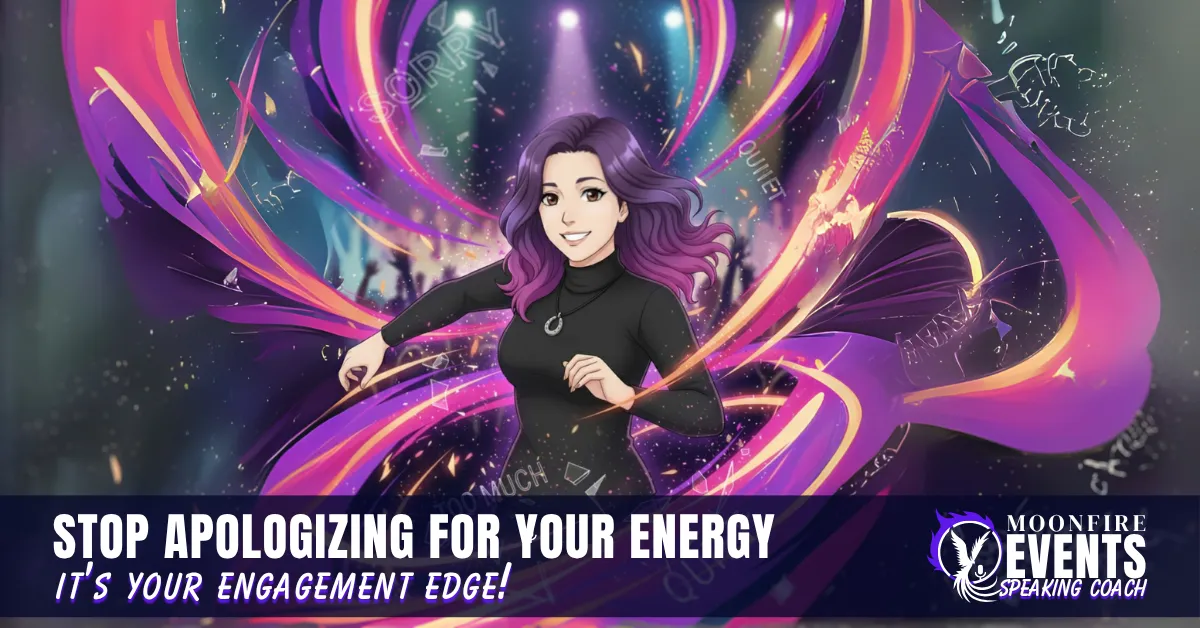
Stop Apologizing for Your Energy: It's Your Engagement Edge
Stop Apologizing for Your Energy: It's Your Engagement Edge
You're Not Too Much - You're Just Unfiltered
"Sorry, I'm a little excited."
"Sorry if I'm talking too fast."
"Sorry for going off on a tangent."
How many times have you said those words mid-presentation?
Here's the truth no one's telling you: the thing you keep apologizing for is the exact thing that makes you magnetic.
Your energy shifts.
Your bursts of passion.
Your "too muchness."
These aren't liabilities - they're the spark that keeps people awake.
From the time we were little girls, we were taught to tone it down.
Don't be too loud.
Don't talk too fast.
Don't make others uncomfortable.
So by the time we're women in business, we've internalized a lie: that our energy is dangerous.
But when you flatten your energy, you don't look more professional. You look less alive. And aliveness is what audiences crave.
The 'Tone It Down' Lie We've Been Sold
Let's call it what it is: a conditioning campaign.
The message was clear:
Don't be too loud.
Don't talk too fast.
Don't get carried away.
Don't make others uncomfortable with your intensity.
So we learned to apologize.
For our excitement.
For our tangents.
For the moments when our passion leaked through our "professional" veneer.
We learned that our energy needed to be managed, contained, and constantly apologized for. That being "too much" was the cardinal sin of business presence.
But here's what they didn't tell us: the people who change minds, move markets, and build movements are never the ones playing it safe with their energy.
What Apologizing for Your Energy Actually Costs You
Every time you say "sorry for being excited," you're training your audience to see your passion as a problem.
They start watching you instead of listening to your message.
You lose authority.
You lose presence.
And worst of all? You start believing the lie yourself.
You dim your voice in client calls. You second-guess your ideas in meetings. You walk off stage feeling like you got away with something instead of knowing you killed it.
The ripple effect is real:
Your team picks up on your self-doubt and mirrors it back
Your clients sense the incongruence between your message and your delivery
Your revenue plateaus because your presentations don't convert like they should
Your burnout accelerates because performing "calm and contained" for hours is exhausting
That's not sustainable. And it's definitely not scalable.
Meanwhile, you're watching other entrepreneurs - often less experienced, less knowledgeable - command attention and close deals. Not because they have better offers, but because they're not afraid to take up space with their energy.
Energy Is Your Transmission System, Not Your Liability
Here's what most presentation advice gets wrong: they treat energy like a volume knob. Too high? Turn it down. Too low? Pump it up. Find the "right" level and stay there.
But energy isn't a setting. It's a transmission vehicle for your message.
It's what makes people lean in, pay attention, and remember what you said three weeks later when they're ready to buy.
When you suppress your natural energy:
Your delivery goes robotic.
Flat tone, flat affect, flat impact.
You sound like you're reading a script you don't believe in - because in a way, you are. You're performing "professional" instead of being powerful.
Your audience checks out. They feel nothing, so they remember nothing.
The research is clear: emotional engagement drives memory and decision-making. When you strip the emotion from your delivery, you strip the memorability from your message.
You leave drained. Because you spent your whole presentation self-policing instead of self-expressing. You monitored every gesture, second-guessed every inflection, and held your breath through every silence.
What looks like inconsistency to you - those bursts of high energy followed by softer dips - is actually natural rhythm. It's the contrast that creates engagement. It's the variation that keeps brains alert and bodies leaning forward.
Your "too muchness" isn't the problem. The suppression of it is.
Ride Your Energy Waves Instead of Flattening Them
I know what you're thinking: "But what if I'm actually TOO much? What if I lose people?"
Here's what I've learned from working with many neurodivergent women: the problem is never your energy. The problem is inconsistency born from self-doubt. When you stop second-guessing yourself mid-sentence, your energy becomes a tool, not a liability.
Instead of apologizing for your energy shifts, start using them as intentional engagement architecture.
Three Ways to Turn Your Energy Into Your Engagement Edge:
1. Start with a Spark. Open with your natural high-energy burst. Don't warm up to it - lead with it. Set the tone, grab attention, establish that this is going to be different. Then let yourself settle into your natural rhythm. That initial spike creates permission for everything that follows.
2. Use Contrast as Your Secret Weapon. Don't fear your dips - pair them deliberately with your spikes. Loud to soft. Fast to slow. Expansive gesture to complete stillness. The contrast is what makes people listen. Monotone (even high-energy monotone) is what makes them tune out. Your natural variability isn't a bug - it's the feature that keeps audiences tracking with you for an entire presentation.
3. Name It Out Loud. Say, "I'm letting my excitement show here" or "This part fires me up" or "Notice how your energy shifts when I shift mine." That vulnerability turns your intensity into credibility. It transforms what could read as "out of control" into "authentically connected to this material." You're not apologizing - you're inviting your audience into your experience.
Bonus move for the brave: When you feel yourself about to apologize, do the opposite. Gesture bigger. Let your voice rise. Drop to a whisper. Laugh mid-slide. Let your passion spill without commentary. Watch what happens. (Spoiler: people lean in, not away.)
Permission Granted: Your Energy Doesn't Need Fixing
Here's your permission slip, signed and dated:
Stop apologizing for your energy. It doesn't need to be tamed - it needs to be trusted.
Your intensity isn't making people uncomfortable. Your apology for it is. Because every time you say sorry for being excited, you're asking your audience to join you in doubting yourself. And they will.
But when you own your energy shifts? When you ride them instead of resisting them? Something magical happens:
Your confidence stabilizes (because you're not fracturing your attention between content and self-monitoring)
Your message lands deeper (because emotional transmission is finally aligned with intellectual content)
Your audience engagement skyrockets (because humans are wired to respond to authentic aliveness)
Your stages get bigger (because event organizers book speakers who make audiences feel something)
The entrepreneurs who build movements aren't the calm, controlled, consistently-toned presenters. They're the ones brave enough to let their passion show, their energy shift, their humanity be visible.
Rebel move? Next time you feel yourself holding back, do the opposite. Gesture bigger. Let your voice rise. Drop to a whisper. Laugh mid-slide. Let your passion spill.
That's not messy. That's magnetic.
The Rule We're Burning
The old rule: "Tone it down. Be calm. Be contained."
The new rule: "Stop apologizing. Be alive. Be unforgettable."
Your energy isn't a liability. It's your engagement edge. And the world doesn't need you smaller - it needs you bigger. It needs your aliveness, your passion, your refusal to flatten yourself for the comfort of people who were never going to buy from you anyway.
The entrepreneurs making waves? They're not the most polished. They're the most present. And presence requires energy - the kind that shifts, spikes, dips, and soars without apology.
So stop training your audience to see your passion as a problem. Start showing them that your "too muchness" is exactly why they can't look away.
Ready to Channel Your "Too Muchness" Into Magnetic Stage Presence?
Your energy doesn't need a dimmer switch. It needs a stage, a strategy, and permission to take up every inch of space you've been apologizing for.
If you're done playing small and ready to design presentations that turn your natural intensity into your most powerful business asset, let's talk.
👉Book Your Curiosity Call and let's explore what's possible when you stop apologizing and start owning the room.
Claudine Land The Virtual Event Whisperer | Founder, MoonFire Events
Where "too much" becomes your greatest business asset
Core Questions
Q: Why do presenters apologize for their energy?
A: Many ND women are conditioned to believe their passion, speed, or tangents make them “too much.” They apologize to seem more “professional,” but it actually undermines credibility.
Q: Is being “too much” bad for presentations?
A: No. What feels like “too much” is often what keeps audiences engaged. Energy shifts, passion bursts, and tangents create contrast - the very thing that sustains attention.
Q: What happens when you flatten your energy in a presentation?
A: Your delivery goes robotic, audiences disengage, and you leave drained from self-policing. Flatness kills memorability, while authentic energy drives connection.
Q: How can presenters use their energy as an advantage?
A: Ride your energy waves instead of resisting them. Use contrast (loud/soft, fast/slow), start with a high-energy spark, and name your excitement out loud.
Q: Why is ND energy an engagement edge?
A: ND brains naturally bring rhythm, intensity, and emotional honesty to the stage. These qualities build trust and keep audiences awake - far more than polished monotone delivery.
Q: Should I apologize if I get too excited while speaking?
A: No. Apologizing signals self-doubt. Instead, amplify it: gesture bigger, laugh, pause, or whisper. Authentic energy is magnetic, not messy.

© 2025 MoonFire Events | Forge connections. Fuel growth. Own your stage.
Follow: LinkedIn | Instagram | YouTube | TikTok | Facebook