MoonFire Chronicles
Your ultimate resource for mastering live virtual events. Dive into a treasure trove of tips, tricks, and tactics designed to empower entrepreneurs. Whether you're just starting or looking to elevate your game, these articles are to help guide you every step of the way. Join us on this journey and unlock the magic of unforgettable events!
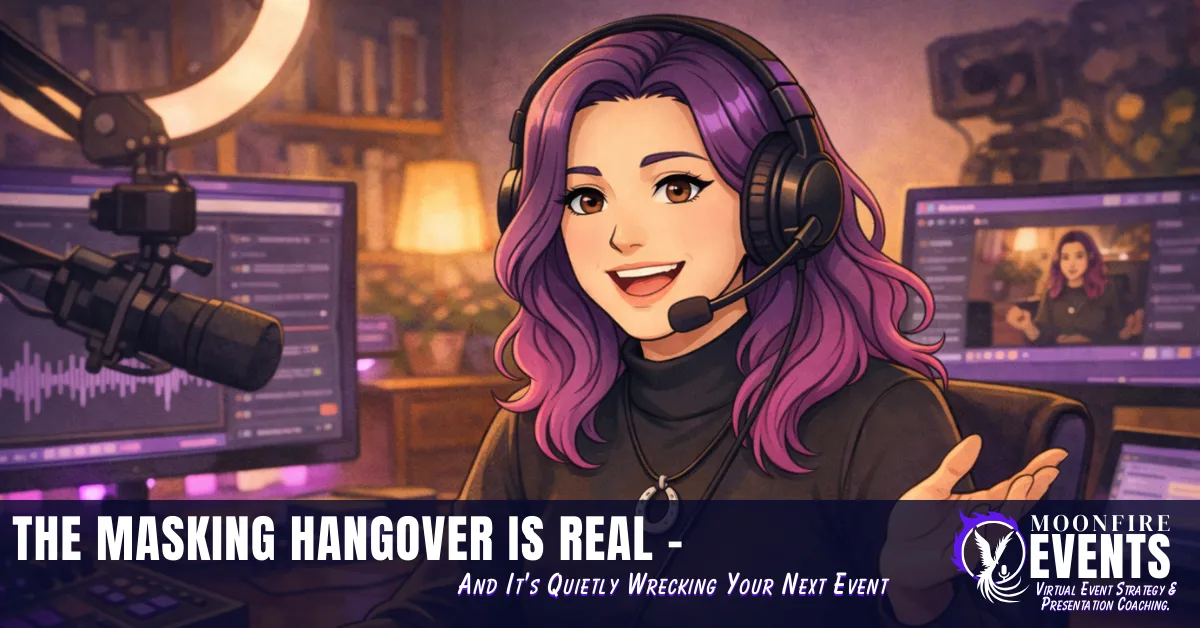
The Masking Hangover Is Real - And It's Quietly Wrecking Your Next Event
MoonFire Events | The Virtual Event Whisperer | Energy Management & Sustainability
You closed out the event. You thanked the last attendee, waved goodbye to the camera, and clicked "End Meeting."
And then you just… sat there.
Not tired in the way that a long day makes you tired. Something deeper than that. Something that felt a lot like being scraped clean from the inside. Your brain was still running - replaying the part where you lost your train of thought, cataloging the question you should have answered better - but your body had completely checked out. You had nothing left.
Maybe you told yourself you just needed a good night's sleep. Maybe you pushed through and opened your inbox anyway. Maybe you scheduled another event for three days later because you thought the first one went well, and you figured the energy would just… come back.
It didn't. Or it came back slower than you expected. Or the second event felt twice as hard as the first, even though nothing had technically changed.
Here is what nobody in the virtual event world will tell you: what you experienced has a name, and it is completely normal. It's not burnout (though it can lead there). It's not a confidence problem. It's not evidence that you're not cut out for this.
It is the documented, well-understood cost of performance energy. And professional performers - actors, athletes, musicians, speakers - have known about it for a very long time.
The difference is that their industries built protocols around it. Yours didn't.
In this post, we are naming the cost, borrowing from what professional performers have known for decades, and building a simple framework you can use before and after every virtual event you run - whether you are the host, the producer, or (most likely for solopreneurs) both at the same time.
The Performance Tax Nobody Warned You About
Let's start with what is actually happening when you show up to run a virtual event.
You are not just talking into a camera. You are managing your energy, your pacing, and your delivery in real time. You are monitoring audience engagement - the chat, the reactions, the faces - while simultaneously tracking what you still need to cover. You are making micro-adjustments to your tone, your speed, your presence dozens of times per minute, often without realizing it.
And if you're a solopreneur running your own events, you're doing all of that while also watching the tech, managing any speakers or guests, keeping an eye on the clock, and staying ready to troubleshoot whatever goes sideways.
That is not one job. That is three or four jobs running simultaneously, all of them requiring your full attention.
This is what we mean by performance energy: the cognitive, emotional, and physical output of showing up as an intentional, managed, present version of yourself in front of an audience - while simultaneously managing the environment around you.
Every professional performer pays this tax. Every single one. The actor who gives a two-hour performance. The athlete who runs a race or plays a full match. The musician who holds an audience's attention for ninety minutes. They all pay it. The cost is real, it's physiological, and it doesn't negotiate.
The virtual event world just never told you that you were paying it too.
Permission slip: The fatigue you feel after running a virtual event is not a weakness. It is not poor preparation. It is proof that something real happened - that you were genuinely present and genuinely performing. That costs something. Acknowledging that cost is the first step to managing it.
The question is not how to avoid the tax. You cannot. The question is whether you have a system to manage it - or whether you are just absorbing it and hoping for the best.
What Actors and Athletes Know That Virtual Event Hosts Don't
In professional performance fields, pre- and post-performance protocols are not optional. They are not self-care add-ons or nice-to-haves. They are standard operating procedure - built directly into the professional practice of anyone who performs at a high level on a consistent basis.
Consider what an actor does before a performance. There is a warm-up - physical, vocal, mental. There is a ritual that marks the transition from regular life into performance mode. There is often a deliberate narrowing of focus, a process of stepping into the specific presence and energy required for the role they are about to inhabit.
After a performance, there is a deliberate cool-down. A process of stepping back out. Cast members debrief. Directors give notes. There is a formal transition from performance mode back into regular life, because experienced performers know that if you skip it, the adrenaline and the cortisol and the residual performance energy do not just evaporate. They linger. They disrupt your sleep, your next day, your capacity for the next performance.
Athletes know the same thing. Warm-up and cool-down are not secondary to training - they are part of training. Skipping the cool-down is how you get injured, how you accumulate fatigue faster than you recover from it, how a sustainable practice becomes an unsustainable one.
Here is the uncomfortable truth: the virtual event industry grew out of corporate meeting culture. And corporate meeting culture does not acknowledge performance cost. It treats "being on a call" as a passive activity, something you can stack back-to-back for eight hours with a five-minute break between them. It was never designed around the reality of genuine on-camera presence, genuine audience engagement, or the very real cognitive load of running production while also performing.
So nobody built the protocols in. Nobody told you that going live is a performance. Nobody gave you the warm-up sequence or the cool-down ritual or the recovery buffer. They just expected you to show up, be great, and then immediately answer your emails.
That ends here.
After analyzing and being involved in over 50 virtual events and spending thousands of hours in research, training, and education around virtual event production, on-camera presence, and audience engagement - the pattern I keep seeing is not low-quality content, poor tech, or unprepared hosts. It's the complete absence of performance infrastructure. People who are genuinely talented and genuinely prepared are burning out not because the work is too hard, but because they're doing it without any of the support systems that professional performers take for granted.
Whether you're a solopreneur running a monthly workshop, a coach hosting weekly group calls, or a business owner who shows up on camera regularly for your community - you are a performer. Your events are performances. And you deserve the same intentional infrastructure that every other professional performer builds their practice around.
The Pre-Event Performance Protocol: Your Warm-Up
Most solopreneurs have a pre-event checklist. It usually looks something like: test the tech, check the slides, confirm the link went out, maybe run a quick audio check. All of that is production prep, and it matters.
But there is a second category of pre-event preparation that almost nobody does: performance prep. And without it, you are walking onto the stage cold.
Think about what a cold start actually feels like. You're in your inbox or your to-do list, your brain scattered across six different tasks, and then suddenly you're live. You have to immediately shift into presence, into warmth, into engagement - with no transition, no warm-up, no intentional shift in state. It takes ten or fifteen minutes just to find your rhythm. And by then, you've already lost the first impression.
A pre-event performance protocol is not complicated. It doesn't need to be long. But it does need to be intentional and consistent, because the point is not just preparation - it's ritual. A repeatable sequence that signals to your nervous system: we're shifting into performance mode now.
And here's what makes me genuinely angry about this: every professional performing field figured this out a long time ago. Theater programs teach warm-up protocols. Athletic coaching certifications require a cool-down methodology. Even corporate speaking coaches cover pre-stage rituals. But the virtual event world? It handed you a Zoom link, wished you luck, and expected professional-grade presence with zero professional-grade preparation infrastructure. That is not a “you” problem. That is an industry gap - and you can close it starting with your next event.
A Simple Pre-Event Sequence (30–60 Minutes Before Go-Time)
Close the noise. Inbox, Slack, social media - closed. Not minimized. Closed. You cannot shift into performance mode while you are half-monitoring seventeen other things.
Do your production check as a calming ritual, not a panic sprint. Tech check, slides, links, audio - run through these deliberately and slowly. If something is off, you have time to fix it. If everything is fine, you have just given your nervous system a proof point that things are in order.
Move your body. This does not have to be a workout. Five minutes. Shake out your hands, roll your shoulders, do some light movement that breaks you out of screen posture and signals physical aliveness. Athletes warm up their bodies before performance. So do actors. There is a reason.
Warm up your voice. Even if you're not doing vocal exercises, speak out loud for a few minutes before you go live. Your voice needs to be warm and ready, not hearing itself for the first time when you greet your audience.
Set your intention for this event. One sentence: what do you want people to walk away feeling? Not the information they will have - the feeling. That clarity creates a through-line that shapes everything about how you show up.
Imagine if you ran through a version of this before every event - even a shortened ten-minute version. You would arrive at go-time already warm, already settled, already in the specific presence that your audience needs from you. Not scrambling into it fifteen minutes late.
One thing worth naming here: predictable pre-event rituals also reduce cognitive load in a meaningful way. When the sequence is set, you are not making decisions about how to prepare. You are just executing. For anyone whose brain uses extra energy on transitions, task-switching, or uncertainty - and honestly, that is most people who run events - a consistent ritual creates a reliable on-ramp that makes the whole launch smoother.
Rebel action: This week, block thirty minutes before your next event as 'pre-event protected time.' No calls, no email, no last-minute prep. Use it to run your performance warm-up. Notice what is different about how you start.
The Post-Event Recovery Protocol: Your Cool-Down
If the pre-event protocol is underused, the post-event protocol is almost completely nonexistent in the virtual event world.
Most solopreneurs close their laptop within ten minutes of ending an event and immediately shift into whatever comes next. Answering the emails that piled up. Jumping on a client call. Eating lunch while scrolling. The event is over, so they move on.
But here's what's actually happening in your body and brain during a virtual event. Research on cortisol and public speaking consistently shows that performance situations - including screen-based, high-stakes formats - trigger measurable stress hormone responses.¹ Your heart rate is up. Cortisol rises. Adrenaline does its job, keeping you sharp, responsive, and present. Your nervous system is in a heightened state because it is doing exactly what it is supposed to do during a high-stakes, high-engagement performance.
When you click "End Meeting" and immediately open your inbox, that elevated state does not simply switch off. The nervous system needs a signal - a deliberate transition - to begin moving back toward baseline. Without it, you are asking your system to regulate itself while simultaneously starting something new.
This is partly why you feel scattered or irritable in the hour after an event, even when it went well. It's why you can feel simultaneously wired and exhausted. The performance energy has nowhere to go.
Athletes cool down after competition because, as sports science research on post-exercise recovery confirms, an intentional cool-down period - even a brief one - supports faster psychological recovery than an abrupt stop, even when the physiological markers normalize on their own within the hour.² The same principle applies here. You are not cooling down a body that ran a race. You are giving your nervous system a clear, structured signal that the performance is over.
The fact that you have to name this and build it yourself - that the virtual event industry never handed you a recovery protocol the way a theater program hands an actor one - is genuinely frustrating. But it also means you get to design it in a way that actually fits your events, your brain, and your life. That's not a consolation prize. That's an advantage.
A Simple Post-Event Cool-Down (20–30 Minutes After You Close the Room)
Do a two-minute brain dump before you close anything. While it is fresh: what worked, what you would adjust, any follow-up items. Do this immediately. You will not remember it as clearly in an hour, and trying to reconstruct it later costs more energy than capturing it now.
Step away from the screen. Physically leave your workspace for at least ten minutes. Walk outside if you can. This is not a reward. It is the transition ritual - the physical act of stepping out of performance mode and back into regular-life mode. Your nervous system responds to physical environment cues. Give it a clear signal.
Eat something if you have not. Many solopreneurs forget to eat before events (too busy) and then crash hard afterward. Blood sugar matters. This is basic performance biology.
Do not schedule anything cognitively demanding in the first hour post-event. This is not always possible, but it is worth designing for. In the first hour after a high-engagement performance, your capacity for complex thinking, creative work, or high-stakes conversations is reduced. Protect it where you can.
Separate your debrief from your recovery. The brain dump above is not your full post-event debrief - that is a separate activity that belongs in a different time slot. Recovery first. Analysis later. Conflating them means you do neither well.
Permission slip: You are allowed to schedule recovery time after your events. It is not self-indulgent. It is not unproductive. It is the professional infrastructure that makes showing up consistently possible.
One more thing worth saying clearly: the depth of your cool-down should scale with the intensity of your event. A thirty-minute community Q&A has a different energy cost than a two-hour workshop where you're the host, the speaker, and the producer. Be honest with yourself about what each event actually costs, and build your recovery accordingly.
Building the Energy Infrastructure Into Your Event Calendar
Here is the structural problem most solopreneurs run into: they schedule the event. They do not schedule the energy around the event.
Your calendar has a block for the event itself. It probably does not have a block for pre-event performance prep. It almost certainly does not have a block for post-event recovery. And if you run multiple events in a month, the calendar probably has them spaced based on content needs or audience timing - not based on your actual recovery capacity.
This is how the debt accumulates. Not dramatically. Gradually. Event by event, you are withdrawing from your energy reserves without making corresponding deposits. The events feel progressively harder. Your delivery gets flatter. You start to dread things you used to look forward to. And you blame your commitment, or your confidence, or your scheduling, when the real culprit is the absence of recovery infrastructure.
What to Actually Block in Your Calendar
Pre-event buffer: 30–60 minutes before every event, blocked as protected performance prep time. No meetings, no email, no client calls.
Post-event recovery window: 20–60 minutes after every event, blocked for cool-down and the immediate brain dump. Non-negotiable.
Debrief slot: Separate from recovery - ideally scheduled later the same day or the following morning, when you have perspective and capacity. This is where you do the real analysis: what worked, what to adjust, what to carry forward.
Recovery day spacing: If you run multiple events in a week, be deliberate about spacing. Your body and brain need time between performances. Building in at least one full non-event day between high-energy events is worth protecting.
This is also a production decision, not just a personal one. When you build your event run-of-show and your event calendar, the energy infrastructure belongs in the same document as the tech checklist and the speaker bios. It is part of your production plan.
A Word on Co-Pilot Support
One of the less-discussed benefits of bringing in a virtual event co-pilot is what it does to your performance energy on event day.
When you are the host AND the producer, your cognitive load is split. Part of your attention is always on the tech, the clock, the chat management, the behind-the-scenes logistics. That is attention that cannot be fully present with your audience. And it adds meaningfully to the performance tax you pay.
When a co-pilot handles the production side, you can be fully in the Performer role. You are not monitoring the waiting room while trying to hold your opening presence. You are not watching the clock while you are mid-answer on a great question. You are just performing.
The recovery math changes considerably when that cognitive split is removed. The event still costs you something - good performances always do - but the cost is more predictable, more manageable, and the recovery is significantly faster.
That is not a pitch. That is performance physics.
Your Energy Is Part of Your Production Plan
Here is the bottom line: every professional performer who sustains their work over time does it because they have built recovery into their practice by design, not by accident.
The virtual event world never gave you that framework. It expected you to show up, perform at your best, run your own production, and then immediately move on to the next thing - with zero acknowledgement that what you just did had a real, measurable cost.
Actors know the cost. Athletes know the cost. Musicians know the cost. Now you know it too.
What you do with that knowledge is the difference between a practice that drains you and one that sustains you.
You do not need to overhaul your entire workflow this week. Start small: add the pre-event buffer to your next event. Block thirty minutes after for cool-down. Do the two-minute brain dump before you close anything. See what shifts.
The events that feel the hardest are often the ones where the energy infrastructure around them is the thinnest. Give yourself the infrastructure. You have earned it.
Ready to take a look at what your current event practice is actually costing you?
If you're not sure whether your event schedule is sustainable - or you keep hitting walls after events and can't figure out why - let's talk it through. A free 30-minute conversation can help you see what's working, what's draining you, and where a few structural changes could make a real difference.
Sources
¹ Schmidt, S., et al. (2020). "The Influence of Cortisol, Flow, and Anxiety on Performance in E‐Sports: A Field Study." BioMed Research International. https://pmc.ncbi.nlm.nih.gov/articles/PMC7008303/
Supporting: Jezova, D., et al. (2016). "Psychosocial stress based on public speech in humans: is there a real life/laboratory setting cross-adaptation?" Stress: The International Journal on the Biology of Stress. https://www.tandfonline.com/doi/full/10.1080/10253890.2016.1203416
Supporting: Kaschak, E., et al. "The Stress of Public Speaking Increases Cortisol Levels in Undergraduates: Is Increased Preparation Really the Best Remedy?" Molloy University Digital Commons. https://digitalcommons.molloy.edu/bces_fac/17/
² van Hooren, B. & Peake, J.M. (2018). "Do We Need a Cool-Down After Exercise? A Narrative Review of the Psychophysiological Effects and the Effects on Performance, Injuries and the Long-Term Adaptive Response." Sports Medicine. https://pmc.ncbi.nlm.nih.gov/articles/PMC5999142/

© 2025 MoonFire Events | Forge connections. Fuel growth. Own your stage.
Follow: LinkedIn | Instagram | YouTube | TikTok | Facebook