
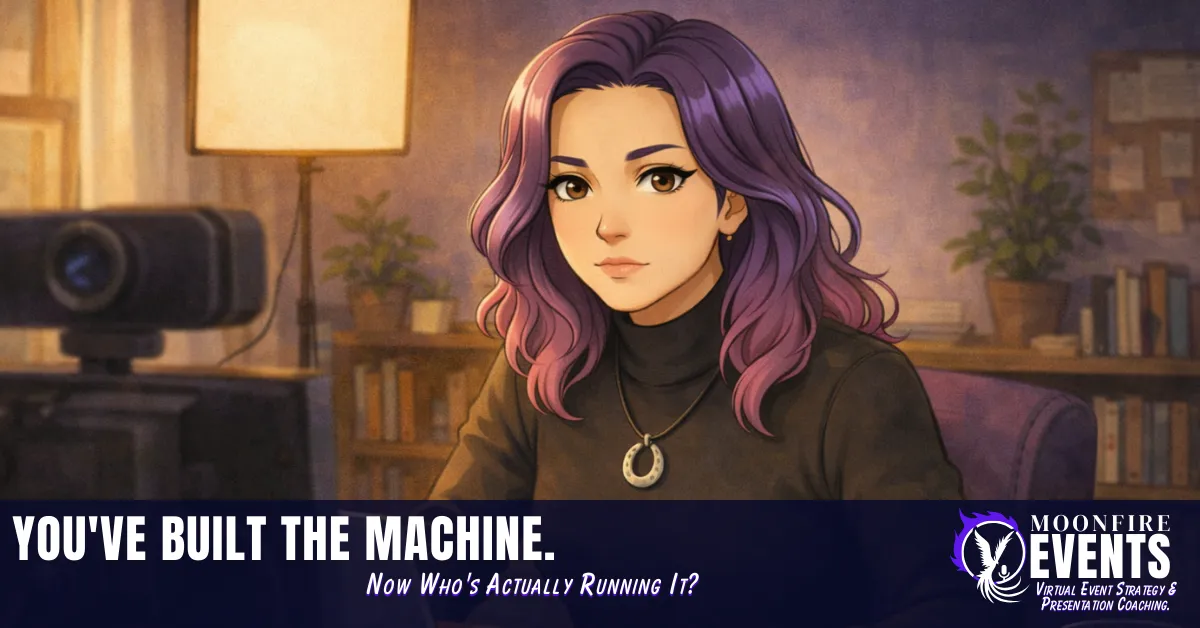
You've Built the Machine. Now Who's Actually Running It?
MoonFire Events | The Virtual Event Whisperer | On Camera Presence
Everything is ready.
Your platform is set up. Your slides are clean. You've tested your audio twice, checked your lighting, drafted your run-of-show, and sent the reminders. You know your content. You've done the prep.
And then you hit go live - and something shifts.
Not the tech. The tech is fine. You shift. Your voice flattens. Your energy pulls back. The version of you that was clear and confident during the rehearsal seems to have quietly stepped out of the room, and in its place is someone performing the idea of a prepared presenter - stiff, monitoring, scanning for the moment something goes wrong.
The machine is running perfectly. The person operating it has just gone somewhere else entirely.
If you've ever finished a virtual event feeling like you left something on the table - not technically, but personally - this is the gap I want to talk about today. Not because there's something wrong with you. But because nobody talks about this part, and you deserve an honest explanation of what's actually happening.
In this post, we're going to cover:
Why a well-built event setup doesn't automatically translate to a confident, magnetic on-camera presence
The specific moment the handoff from Producer to Performer breaks down - and what's actually going on when it does
What the Performer Track is, who it was built for, and why it works differently than every other presentation approach you've tried
How the REBEL Method addresses the gap at the level of brain wiring - not performance polish
Three concrete things you can do right now, before you ever book anything or buy anything, to start closing that gap yourself
Your next step - and why a single honest conversation might be all you need to find it
Let's get into it.
Why Your Virtual Event Setup Isn't Fixing Your On-Camera Presence (And What Actually Will)
Here's a pattern I've seen consistently across the 50+ virtual events I've analyzed and been involved with, and across thousands of hours of research, training, and education in virtual event production and on-camera presence: solopreneurs who invest heavily in their Producer skills eventually hit a ceiling that no amount of Producer work can raise.
They've done the right things. Better audio. A proper lighting setup. A platform they actually understand. A run-of-show that accounts for tech hiccups, speaker delays, and engagement lulls. All of it is legitimate progress - the Producer Track exists precisely because that infrastructure matters and most solopreneurs are building it without any roadmap.
But there's a ceiling. And it's not a tech ceiling.
It's the moment when the solopreneur realizes that the event can be technically flawless while still feeling flat, disconnected, or exhausting - for them and, often, for their audience. The setup is solid. The delivery is still the problem.
The story most people tell themselves at that ceiling is a familiar one: I'm just not good on camera. It sounds like an observation. It feels like a conclusion. But it's actually neither - it's a story that fills the space where an explanation should be.
The real explanation is this: nobody taught you to present as yourself. They taught you to present as a competent, composed, professional-sounding version of yourself - which is a fundamentally different task, and one that requires you to monitor and suppress the parts of your communication style that are actually your greatest strengths.
For neurodivergent entrepreneurs especially, this hits differently. Masking - the cognitive and emotional labor of performing neurotypical norms - is taxing under ordinary circumstances. Add a live audience, an active camera, real-time chat, and the responsibility of managing the entire technical environment simultaneously, and the mask becomes unsustainable. What surfaces in the recordings later isn't a lack of talent. It's the visible cost of an impossible cognitive load.
That's not a confidence problem. That's a capacity problem. And the distinction matters, because they have completely different solutions.
Permission slip: You can stop trying to fix your on-camera presence by upgrading your Producer systems. That's not where the answer lives.
Rebel action: Before your next event, spend 10 minutes on you - not your slides, not your tech stack. Just ask yourself honestly: what does my nervous system need right now to show up present? That single question will do more useful work than a fourth run-through of your slide deck.
The Producer-to-Performer Handoff: The Moment Everything Gets Hard
There's a specific moment in every virtual event where the work shifts - and most solopreneurs manage it entirely by accident.
It happens about 60 seconds before go-live.
The checklist is done. The slides are queued. The waiting room is filling up. The tech is behaving. And suddenly there's nothing left to do except show up - and your brain, which has been in full logistics mode for the last 45 minutes (or the last three days), is not ready to make that switch.
This is the Producer-to-Performer handoff. And for most solopreneurs, it's completely unmanaged.
Here's why it's hard: the Producer brain and the Performer brain are doing fundamentally different kinds of work. The Producer brain is in problem-solving mode - scanning for errors, tracking the timeline, managing contingencies, holding the entire run-of-show in active memory. It's alert, analytical, and running on controlled urgency. That's exactly what event production requires.
The Performer brain needs something entirely different. It needs to be in connection mode - present to the audience, responsive to the room, expressive, open, and not running a parallel checklist in the background. The Performer brain needs to feel settled, not alert.
These two states are not compatible. You cannot be in full production-management mode and full audience-connection mode at the same time. One will always compromise the other - and for solopreneurs who are both the producer and the presenter, what usually gets sacrificed is the presence.
What this looks like in practice: you hit go-live, you deliver your content competently, you handle the logistics - and somewhere in the recording, about 8 minutes in, you can see yourself relax slightly and something shifts in your delivery. That's not the point where you got comfortable. That's the point where your nervous system finally finished switching modes on its own, without any help from you.
The good news is that you can make that transition deliberate instead of accidental. You can build a go-live ritual - even a 60-second one - that signals to your nervous system: Producer mode is done. Performer mode is starting now.
It doesn't need to be elaborate. Three breaths. A physical reset - roll your shoulders, uncross your arms, feel your feet on the floor. One sentence said out loud or internally that marks the transition. The content of the ritual matters less than the consistency of it. The goal is simply to create a reliable signal that your brain learns to recognize as the switch.
Permission slip: The handoff doesn't have to be seamless. You're allowed to feel the shift. You're allowed to need a moment before you go live. That is not unprofessional - it's honest, and it's smart.
Rebel action: Write a single sentence that marks the handoff for you. Something like: "The Producer is done. The Performer is here." Say it out loud before every event for 30 days and pay attention to what changes in your delivery.
A note for ND brains specifically: task-switching is genuinely more demanding for many neurodivergent people - research on executive function in ADHD and autism consistently points to this as a neurological difference, not a character flaw or willpower issue. Building an explicit transition ritual isn't a workaround or a crutch. It's working with how your brain actually functions. That's not a compromise. That's intelligent design.
What the Performer Track Actually Is - And Why It Works Differently for Neurodivergent Entrepreneurs
The Performer Track is the on-camera presence side of MoonFire Events. It was built specifically for solopreneurs who are capable and prepared and still struggling to show up the way they want to - not because they lack confidence or talent, but because no one has ever given them a framework that works with their actual communication style instead of against it.
Let me be clear about what it's not.
It's not a public speaking course. It's not "10 tips for better eye contact." It's not the standard presentation coaching advice that tells you to slow down, smile more, and practice until you feel natural - because if you're neurodivergent, practicing a neurotypical script doesn't make it feel natural. It makes it feel more exhausting. You get better at performing the performance, which is the opposite of what you're actually trying to do.
Traditional presentation coaching was designed for neurotypical presenters in physical spaces. It assumes linear, scripted delivery. It assumes that sustained eye contact is the primary signal of credibility. It assumes that your audience is measuring your authority by how well you conform to a specific set of physical and vocal norms. And it assumes that with enough repetition, any nervous system will eventually calm down.
For ND brains, that model doesn't just fall short. It actively makes things worse. More rehearsal of a neurotypical script means more masking, more cognitive overhead, more performance anxiety - because every time you practice, you're also practicing ignoring your own instincts. You're training yourself to suppress the associative thinking, the nonlinear energy, the genuine enthusiasm for the tangent, the communication style that is actually yours - in favor of something that reads as "professional" to an audience that may not even prefer it.
The Performer Track starts from a completely different question: what are your natural strengths as a communicator, and how do we build a system around those - instead of suppressing them?
That question changes everything about the approach. Instead of training you to conform to a standard, the Performer Track maps your actual communication style - including the parts that previous coaching told you were problems - and builds a presentation framework that uses those traits as assets. Associative thinking becomes a teaching strategy. High energy becomes audience activation. The deep dive becomes a magnetic moment. The nonlinear structure becomes the thing your attendees remember.
Permission slip: You don't have to become a different person on camera. You have to become more yourself. The Performer Track is the framework for doing that systematically, not by accident.
Rebel action: Think of a moment in the last six months when you were genuinely compelling in a conversation - not performing, not monitoring yourself, just fully engaged and present. That's not a fluke. That's your baseline. The work of the Performer Track is building a system that reliably gets you back there, on camera, in front of an audience, under pressure.
The Performer Track was built with neurodivergent entrepreneurs as the primary design standard - not as an add-on accommodation, but as the foundational audience. The result is a framework that works exceptionally well for ND brains and is genuinely more effective for everyone else too. When you design for the most complex use case, you raise the floor for the whole room.
The REBEL Method: An On-Camera Presence Framework Built for ND Brains, Not Corporate Scripts
The REBEL Method is my proprietary framework - the structural backbone of the Performer Track. It was built specifically for ND entrepreneurs and solopreneurs who have tried standard presentation coaching and found it makes things worse, not better.
Here's what each stage actually does:
R - Recognize Before you can build anything, you need an accurate picture of what's actually happening. Not what you think should be happening, not the version of your on-camera presence you've been told to aim for - what's actually happening. Recognize is where you identify your natural communication strengths (the ones previous coaching may have told you to tone down), map your energy patterns, and name the specific neurotypical presentation rules that have been working against you. You can't build a better system without understanding the terrain first.
E - Energize This stage is about designing your presentations around your actual capacity - not idealized, best-case-scenario energy. Energize is where you build pre/during/post presentation rituals that fuel you rather than deplete you, develop recovery protocols that actually work for your brain, and learn to work with your hyperfocus rather than fighting it. The goal is sustainable on-camera presence, not peak performance that requires three days of recovery.
B - Boundaries Connection is the whole point of a virtual event - but connection without structure leads to oversharing, burnout, and the specific kind of emotional hangover that makes ND entrepreneurs avoid showing up again. Boundaries is where you define your personal audience engagement rules: how much you share, what you protect, how you stay genuine without losing yourself in the room. This stage is often the most quietly transformative for ND entrepreneurs who have spent years swinging between "too much" and "completely shut down."
E - Engage This is where you build your signature presence playbook - your repeatable frameworks for magnetic audience connection that are designed for your brain, not borrowed from a neurotypical presenter's handbook. Engage is where you develop the specific strategies, transitions, and connection moments that feel authentic rather than performative. By the end of this stage, you have a presentation approach that you can replicate reliably, not just access on a good day.
L - Launch The final stage brings the full system together. You test it in real or simulated environments, receive strength-based feedback on your presence, refine what needs refining, and leave with your complete REBEL Method playbook - a custom on-camera presence system built around your specific brain, your specific communication style, and your specific audience.
Most presentation frameworks tell you what to do. The REBEL Method tells you why it works for your specific brain - and gives you the tools to rebuild your on-camera presence from that foundation, not from someone else's template.
Permission slip: You're allowed to have a system that was built for you. You don't have to keep forcing yourself into frameworks designed for a completely different kind of brain and then concluding that you're the problem when it doesn't work.
Rebel action: Think about which stage of the REBEL Method you're currently stuck in. Are you in Recognize - not sure what's actually getting in your way? Energize - showing up consistently depleted? Boundaries - oscillating between oversharing and shutting down? Engage - delivering competent content but not connecting? Wherever you are is your entry point. There's no wrong place to start.
Three Things You Can Do Right Now to Close the On-Camera Presence Gap
Here's where I want to be direct with you, in the least salesy way I know how: the most useful thing this post can do is give you something concrete to act on right now, before you consider working with anyone or buying anything.
So let's start there.
Three things you can do on your own, starting this week:
1. Run a real post-event debrief. Most solopreneurs debrief the tech - what worked, what didn't, what to fix next time. Try running a debrief on you instead. Watch 10 minutes of your last event recording and ask: when was I actually present? When did I pull back into performance mode? What was happening in those moments? That data is more useful than any checklist.
2. Build a go-live ritual. Even 60 seconds. Something physical, something verbal, something that marks the transition from Producer mode to Performer mode. Use it consistently for four events in a row and notice what happens to your delivery in the first three minutes of each one.
3. Name your natural strengths on camera. Not the things you've been told to work on - the things that work. The moments in your recordings where you're genuinely compelling. Write them down. That list is the foundation of your Performer framework, and you already have it. You just haven't been building around it.
These three things will move the needle. Not all the way - but meaningfully, and without any outside help.
If you work through them and you're still hitting the same ceiling, that's not a failure of effort. That's a signal that you need a framework built for your specific brain - and a thinking partner who can see what you genuinely can't see from inside your own head. That's what the REBEL Method coaching is for, and that's what a conversation with me is for.
If you want to talk through where you're stuck - no pitch, no script, no pressure - you can book a free 30-minute consultation. We'll look at what's actually getting in your way and what would genuinely help. That's the whole agenda.
The Machine Is Ready. Now What About You?
You didn't do anything wrong by focusing on the Producer side first. Building the infrastructure - the platform, the setup, the run-of-show, the tech - was necessary work. It still is. The Producer Track matters, and getting that foundation solid is not time wasted.
But here's what I want you to hear: the machine doesn't run itself. And the person running it deserves a system as well-designed as the event itself.
After analyzing 50+ virtual events and spending thousands of hours in training, research, and education in virtual event production and on-camera presence, the pattern I keep seeing is this: the solopreneurs who transform their events are almost never the ones who finally found the right platform or the perfect lighting setup. They're the ones who figured out how to show up - consistently, authentically, without burning themselves out in the process.
That's the Performer Track. That's the REBEL Method. And that's what's on the other side of the gap you've been navigating alone.
The machine is built. The question now is who's running it - and whether that person has the support they actually need.
Ready to talk through what's actually getting in your way on camera?
Book a free 30-minute consultation - no pitch, no script. Just an honest conversation about where you are and what would help.
Claudine Land is the founder of MoonFire Events and The Virtual Event Whisperer. She teaches solopreneurs and small business owners to be both the Performer AND the Producer of their virtual events - without corporate budgets, without masking, and without burning out. Her two proprietary frameworks - the REBEL Method (ND-specific on-camera presence coaching) and the Live Virtual Event Lifecycle (virtual event strategic planning and production) - are built for real brains and real budgets.