
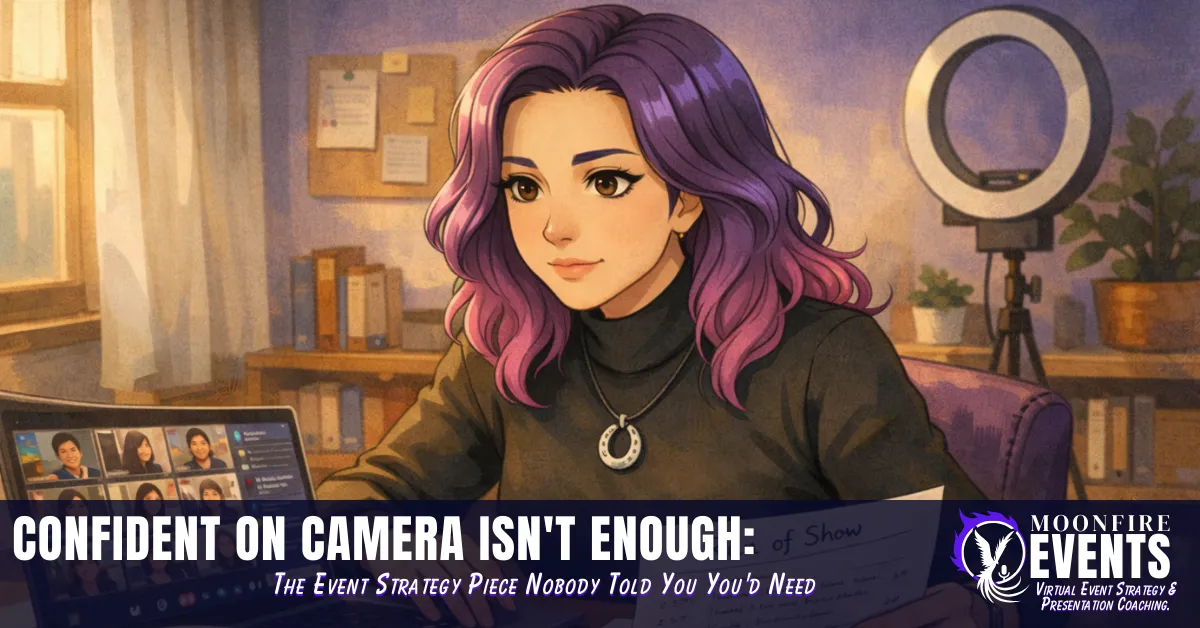
Confident on Camera Isn't Enough: The Event Strategy Piece Nobody Told You You'd Need
MoonFire Events | The Virtual Event Whisperer | Virtual Event Strategy
You did it.
You stopped white-knuckling your way through virtual presentations. You figured out how to show up on camera without the full-body dread, without reading robotically off a script your brain refuses to cooperate with, without performing a version of yourself that exhausts you before you even hit "end meeting." That is not a small thing. That is genuinely, legitimately enormous - and it deserves acknowledgment.
But here's what nobody told you comes next.
You can be magnetic, articulate, and wholly yourself on camera - and still watch your virtual event fall apart in slow motion while you're delivering the best presentation of your life.
Confidence on camera is the entry fee. But it is not the whole ticket.
Here's what I see constantly in the virtual event space, having analyzed and been involved in over 50 virtual events and spent thousands of hours in research, training, and education around virtual event production and on-camera presence: solopreneurs invest real time and energy getting comfortable on camera - and then step into an event with no run-of-show (the minute-by-minute script that keeps everything on track), unclear audience flow, and tech they've never actually tested end-to-end. They deliver a great five minutes, and then something breaks. Or nobody knows when to unmute. Or the Q&A falls into dead silence because there was no facilitation structure. Or the follow-up never happens because the post-event piece was never planned.
And then they blame their presence.
They think I froze or I wasn't engaging enough or maybe I'm just not meant for this - when the real issue was never about how they showed up on camera. The real issue was that nobody handed them a map for everything that surrounds the camera moment.
That's what this post is about.
We're naming the Producer gap - the strategic and logistical layer that makes the difference between an event that works and one that just happened. We're walking through what virtual event strategy actually looks like for solopreneurs running events without a full production team or a $10K budget. And we're introducing the Live Virtual Event Lifecycle: a 7-stage framework that turns "I kind of figured it out" into a repeatable, professional, sustainable system.
If you've done the on-camera work, this is your next layer. The Producer layer. Let's get into it.
The Performer–Producer Split Nobody Warned You About
Here's a truth the presentation coaching industry doesn't advertise: being a great speaker and running a great virtual event require two different skill sets. Not two slightly different skill sets. Two genuinely distinct bodies of knowledge.
The Performer is the person on camera - the one delivering content, building connection, guiding the audience through an experience. On-camera presence, delivery, engagement, the ability to read a room through a screen - that's Performer territory.
The Producer is the architect behind the event - the one who designed the audience journey before anyone showed up, handled the tech setup, built the run-of-show, planned the follow-up sequence, and made sure the whole thing held together structurally. Production strategy, logistics, platform decisions, timing, post-event recovery - that's Producer territory.
In a corporate setting, these roles are split between multiple people. There's a presenter or facilitator on camera, and somewhere behind the scenes there's a tech person, a coordinator, a moderator, and a producer - think of them like a stage manager - keeping the whole thing running. That stage manager role is what a co-pilot fills for solopreneurs who want that support without hiring a full production team.
When you're a solopreneur? You are all of those people. Simultaneously. With no training for half of it.
Nobody tells you that when you sign up for your first virtual workshop. Nobody mentions that the moment you decide to run an event, you've just hired yourself for two completely different jobs with no handoff process between them.
Imagine if you'd spent six weeks preparing for a virtual masterclass - the content was solid, the energy was there, you'd practiced your delivery until it felt natural - and then on the day of the event, your registration page hadn't been set up to send confirmation emails. A third of your registrants never got the join link. You delivered the best version of that session to half the audience who was supposed to be there. The Performer was ready. The Producer hadn't been built yet.
That's the gap. And it's not a reflection of your capability - it's a reflection of the fact that no one ever handed you a Producer framework.
This is the Producer gap. And it's why even the most polished presenters hit a wall with their virtual events.
The good news: the Producer skill set is learnable. It's systematizable. And once you have it, you don't have to rebuild it from scratch every single time. That's exactly what the Live Virtual Event Lifecycle is designed to give you.
What "Virtual Event Strategy" Actually Means for a Solopreneur
Let's clear something up immediately, because the industry loves to make this sound more complicated - and more expensive - than it needs to be.
Virtual event strategy is not:
A $10,000 production package
A full-time tech person on standby
Broadcast-quality studio equipment
A team of three managing your Zoom breakout rooms
Virtual event strategy is:
Knowing what you're building and why before you open any platform
Designing your audience journey from the first registration email to the last follow-up
Making informed decisions about your tech stack based on your actual event needs and budget
Having a run-of-show that tells you exactly what happens, in what order, and what to do when something doesn't
Knowing in advance what you'll do when something goes wrong - because something always goes wrong
Building a post-event process that doesn't drop off a cliff after you hit "end meeting"
That's it. That's the whole thing. It's not glamorous. It's not expensive. It's a set of decisions made in the right order, with a structure that keeps them from all landing on your plate at 11pm the night before your event.
The $10K production myth persists because it's profitable for the people selling $10K production. What I've found, across thousands of hours of research and direct analysis of events across industries and budget levels, is that professional-quality virtual events absolutely can be produced on solopreneur budgets - when you have the strategic framework to make smart decisions. The budget isn't the barrier. The lack of a replicable system is.
Introducing the Live Virtual Event Lifecycle
The Live Virtual Event Lifecycle is a 7-stage framework for planning, producing, and recovering from virtual events - built specifically for solopreneurs who are handling both the Performer and Producer roles themselves.
It's not a checklist. Checklists are useful, but they don't tell you why each step matters, when to do it, or what breaks if you skip it. The Live Virtual Event Lifecycle is a strategic map - one that makes the decisions repeatable so you're not reinventing the wheel every single time you run an event.
Here are the seven stages:
Stage 1: Planning
This is where most solopreneurs either rush through or skip entirely - and pay for it on event day.
Here's the thing nobody wants to admit: skipping the Planning stage isn't a time-saver. It's a time debt. Every hour you don't spend in Stage 1 comes back as two hours of chaos in the week before your event. The industry's obsession with "just get it out there" has convinced solopreneurs that planning is perfectionism. It's not. It's the stage where every other decision gets its instructions.
Planning isn't just deciding what you're going to teach. It's answering the questions that every other decision depends on: Who is this for, specifically? What is the single outcome they're leaving with? What format serves that outcome on your budget? What's the timeline from first promotion to final follow-up? What's your minimum viable registration number?
Permission slip: You are allowed to spend three focused hours in planning before you build anything. That is not overthinking. That is how professional events get built.
Stage 2: Content Creation
Now you build what you're delivering - with your Performer hat firmly on. But even content creation has a Producer layer: How are you structuring the audience journey, not just your slides? Where are the engagement moments? What happens in the transitions? How long is each segment, realistically, not optimistically?
This is where the Performer and Producer tracks genuinely intersect. Great content that's poorly structured for a virtual format will lose an audience. The medium shapes the message - and a virtual audience has different attention patterns than a room full of people who can't quietly open a browser tab.
Stage 3: Tech Setup
Here's where the $10K myth lives and dies. Your tech setup does not need to be expensive. It needs to be tested, reliable, and appropriate for your event type.
Platform choice, audio quality, lighting, backup plans - these are strategic decisions, not luxury upgrades. A clean audio signal and stable internet connection will do more for your professional credibility than a $3,000 camera. Thousands of hours of research and hands-on analysis of virtual events consistently bear this out.
Tech setup also includes your registration flow, your confirmation emails, your reminder sequence, and your day-of logistics. It's not just what's on screen during the event - it's every touchpoint in the audience's experience. And it all needs to be tested before event day, not during it.
Rebel action: Pick the one piece of tech you've been meaning to test and haven't. Do it this week, before you have an audience watching you troubleshoot it.
Stage 4: Promotion
You can run the best virtual event of your life for an audience of zero. Promotion is a Producer responsibility, and it's one solopreneurs chronically underinvest in - usually because they're scrambling to finish the content.
This is backwards. Content takes as long as it takes. Promotion needs lead time. When promotion is built into your Live Virtual Event Lifecycle from Stage 1, it doesn't feel like a last-minute scramble bolted on at the end. It's already part of the plan.
Stage 5: Execution
This is the event itself - and for solopreneurs, it's the stage that reveals every gap in the stages before it.
Execution includes your run-of-show, your tech monitoring, your engagement facilitation, your time management, and your ability to recover when something goes sideways. This is where Producer skills make or break the Performer's moment.
The good news: a well-run Stage 1–4 makes Stage 5 dramatically calmer. You're not solving problems in real time that should have been solved a week ago. You're executing a plan that's already been made.
Stage 6: Follow-Up
The event ended. Your job isn't.
Post-event follow-up is where most of the relationship-building and conversion actually happens - and most solopreneurs abandon it entirely because they're in recovery mode. Here's the honest truth: the follow-up sequence is where revenue lives. The replay email, the next-step offer, the feedback ask, the connection touchpoints - these don't require much energy if they're built in advance. But if they're an afterthought, they don't happen. And a great event with no follow-up is a missed conversion and a relationship that quietly dissolves.
Permission slip: Your event isn't over when the recording stops. And building the follow-up before the event isn't overkill - it's what professionals do.
Stage 7: Iteration
This is the stage that separates solopreneurs who run events from solopreneurs who run better and better events.
What worked? What didn't? What would you do differently? What does your data actually tell you versus what you felt happened in the room? A structured debrief, even a 20-minute one, turns every event into a tuition-free education in your own event production.
The Live Virtual Event Lifecycle isn't a one-time process. It's a repeatable framework - which means every time you run it, you're running it with more information than you had the last time. That's how professional solopreneurs build professional events. Not by getting it perfect the first time. By building a system that gets better every time.
Why This Gap Costs You More Than You Think
Let me be direct about what's actually at stake when the Producer piece is missing.
It costs you the result your audience came for. Imagine if a solopreneur invested months preparing a genuinely transformative workshop - incredible content, real expertise, showing up fully on camera - and a tech glitch in minute three sent half the audience into a waiting room no one knew how to manage. The content was never the problem. The production structure was. That audience doesn't walk away thinking the content was great, the tech just failed. They walk away with a fragmented experience. The result they came for? Interrupted.
It costs you your nervous system. Running an event without a Producer structure means your nervous system is making decisions in real time that should have been made last week. That cognitive load doesn't just affect your event day performance - it feeds directly into the post-event crash that so many solopreneurs, and especially neurodivergent solopreneurs, know intimately. The masking hangover, the depletion, the "I can't do this again for months" feeling? A significant part of that is the unplanned cognitive overhead of winging the Producer role while simultaneously performing.
It costs you the next event. When an event is exhausting and chaotic, you avoid doing another one. Or you do the next one exactly the same way, with the same results. Without the Iteration stage of the Live Virtual Event Lifecycle, you're not building institutional knowledge about your own events. You're starting from scratch every time. That's not sustainable - and it's not necessary.
It costs you revenue. An event without a follow-up sequence is a revenue leak. An event without a clear next-step offer is a missed conversion. These are Producer decisions. The Performer showed up. The Producer didn't close the loop.
The Question That Changes Everything: What Kind of Help Do I Actually Need?
Here's the decision framework - because this isn't one-size-fits-all.
Try DIY first if:
You have the time and genuine interest to build the system yourself
You're in early stages and learning the landscape is part of the value
Your events are relatively straightforward: single speaker, under 90 minutes, audience under 50
You want to deeply understand every layer of your own event production before bringing anyone in
Consider Co-Pilot support if:
You've DIY'd one or more events and know exactly which parts broke
You want to focus entirely on content delivery without managing tech simultaneously
The cost of another chaotic event day is higher than the cost of bringing in support
You're scaling up: larger audience, multi-speaker, longer format, higher-stakes event
Invest in a Strategy Session if:
You're not sure what you don't know yet - and you want a clear map before you build anything
You've been avoiding events because the "how" feels overwhelming
You want to know exactly which platforms, tools, and decisions make sense for your specific event type and budget
You need someone to look at what you're planning and tell you honestly: what's solid, what's missing, and what's going to cause problems on event day
That last one is where the Strategy Session comes in. It's not a coaching program. It's not a vague "let's talk about your goals" conversation. It's a working session where we map your specific event against the Live Virtual Event Lifecycle, identify your actual gaps, and build a clear, actionable plan - so you stop staring at a blank doc wondering where to start and actually run an event that works.
And here's what I want to be clear about: whether you end up DIY-ing the whole thing, bringing in Co-Pilot support, or working together long-term, the Strategy Session gives you something concrete either way - a mapped plan, built on your actual event, your actual audience, and your actual budget. There's no wrong next step after that.
Key Takeaways
The Performer–Producer split is real. When you're a solopreneur running virtual events, you've hired yourself for two different jobs. Both require distinct skills - and both can be learned.
"Virtual event strategy" is not a budget item. It's a set of decisions made in the right order. Professional results don't require corporate budgets. They require a repeatable framework.
The Live Virtual Event Lifecycle gives you 7 stages: Planning → Content Creation → Tech Setup → Promotion → Execution → Follow-Up → Iteration. Skip any stage, and you'll feel it somewhere downstream.
The gap between a great speaker and a successful event is structural, not personal. If your events have felt chaotic, exhausting, or incomplete, the answer is probably not "be more confident on camera."
You have options. DIY the whole system, bring in a Co-Pilot for event-day support, or start with a Strategy Session to map exactly what your events need before you build anything else.
You're Not Missing Confidence. You're Missing a Map.
If you've done the Performer work - if you've invested in your on-camera presence, worked through the anxiety, found your authentic delivery - here's what I want you to hear:
That work is not wasted. Not even a little.
But it's one half of the equation. The solopreneurs who run events that work - that deliver real results for their audience, that convert, that feel sustainable, that they actually want to do again - those solopreneurs have both halves. They're showing up as themselves on camera and they have a structure behind the camera that holds the whole thing together.
The Producer Track isn't a more advanced, more complicated, more expensive version of what you've already done. It's the other side of the same coin. It's the map that makes the confidence you've already built actually land.
You don't have to figure this out alone. You don't have to white-knuckle your way through another event day. You don't have to rebuild the system from scratch every time.
The Live Virtual Event Lifecycle exists so that you build it once - and then run it, refine it, and replicate it. That's what sustainable event production looks like for a solopreneur. Not perfect. Not expensive. Repeatable.
Ready to Bridge the Gap?
If you've done the on-camera work and you know the Producer piece is what's missing, let's build it.
The $495 Strategy Session is a focused, working session where we map your event against the Live Virtual Event Lifecycle, identify your actual gaps, and build a clear plan - specific to your event type, your audience, and your budget.
No guesswork. No generic advice. A real map for your real event.
Not sure if a Strategy Session is the right fit?
Start with a free 30-minute consultation and we'll figure it out together.
Claudine Land is the founder of MoonFire Events and The Virtual Event Whisperer. She teaches solopreneurs and small business owners to be both the Performer AND the Producer of their virtual events - without corporate budgets, without masking, and without burning out. Her two proprietary frameworks - the REBEL Method (ND-specific on-camera presence coaching) and the Live Virtual Event Lifecycle (virtual event strategic planning and production) - are built for real brains and real budgets.