
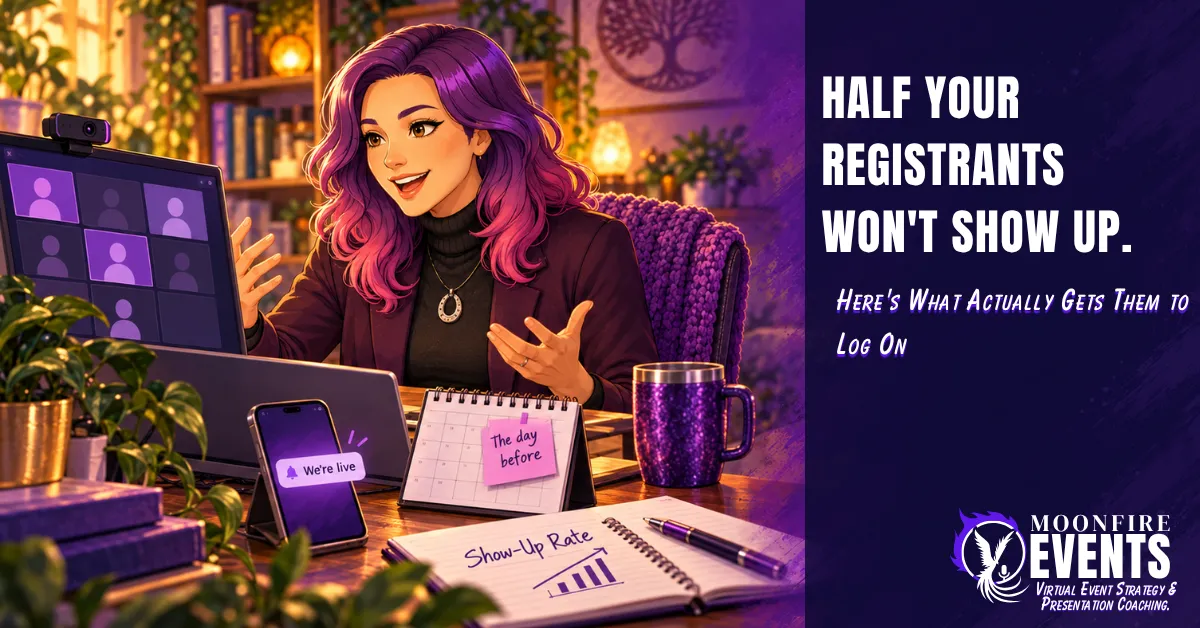
Half Your Registrants Won't Show Up. Here's What Actually Gets Them to Log On
Imagine if you spent three weeks promoting your workshop. The registrations rolled in: 10, then 30, then 80. You did a little happy dance every time your phone buzzed with a new sign-up. You prepped your slides, tested your mic, lit your candle, and logged on ten minutes early.
Then the clock hit go-time, and the room showed a fraction of those 80 names.
And that voice kicks in. Was the topic wrong? Was it me? Did people sign up and then think, "Eh, never mind"?
Let's stop that spiral right here, because the numbers tell a very different story.
Goldcast, a webinar platform, looked at 26,190 webinars from 522 B2B companies and found that the overall attendance rate in 2025 was 40.1% of registrants. ON24, another major platform, reports 60% of registrants attending on its own platform. These are B2B companies running webinars at scale, and somewhere between 4 and 6 out of every 10 people who registered actually showed up.
So a half-empty room isn't a verdict on you. It's the normal gap between "yes, sign me up" and "I'm here."
I've seen low show-up at events myself, and the event went on as planned with the people who were there. That's the part that matters. The event still happens. The people who showed up still get your best. And there are simple, repeatable ways to close some of that gap without guilt-tripping anyone or burning yourself out.
In this post, you'll learn:
- What a "normal" show-up rate really looks like (and why you should stop comparing yourself to registrations)
- Why a registration is a maybe, not a promise
- A reminder cadence you build once and reuse for every event
- Which popular "fixes" to ignore
What a Normal Show-Up Rate Really Looks Like
Let's define the thing first. Your show-up rate (some platforms call it attendance rate) is the number of people who attended divided by the number of people who registered. If 80 people register and 32 attend, your show-up rate is 40%.
That's it. No secret formula.
Here's what the benchmarks say, with one big caveat: every platform measures this a little differently, with its own customers and its own definitions. So treat these numbers as a range, not a report card.
- Goldcast: 40.1% attendance across its 2025 webinar data (source). Its 2026 benchmark report covers 6.8 million registrations and 2.2 million attendees (source).
- ON24: 60% of registrants attended in 2025 (source).
- In-person events aren't immune either. PheedLoop analyzed check-in data from more than 1,070 in-person events and found a median no-show rate of about 20%, with free events around 28% (source).
Now, here's my soapbox moment. Registration numbers are easy to share: "500 people signed up!" Attendance numbers get shared a lot less often. So it's easy to compare your real room to someone else's registration page, and of course that feels like failing.
You're not failing. You're comparing your backstage to their highlight reel.
Permission slip: Stop treating a half-empty room as proof that your topic flopped or that people don't want to hear from you.
How to apply it: After every event, write down three numbers: registrations, live attendees, and replay views if you offer a replay. Divide live attendees by registrations. That's your show-up rate. Do it for two or three events and you'll have something far more useful than any industry benchmark: your own baseline.
Picture this: Your first event has 50 registrations and 18 live attendees. That's 36%. Your next event has 60 registrations and 27 live attendees. That's 45%. Now you have a real trend you can learn from, instead of a vague feeling that "nobody shows up."
Rebel action: Put your show-up rate in your post-event debrief, right next to what went well. Don't hide it. Data you track is data you can improve.
A Registration Is a Maybe, Not a Promise
Here's something that changes how you think about sign-ups: when someone clicks "register," they're making a promise to their future self. And future selves are busy.
The gap between sign-up and go-time can be long or short. ON24's earlier data (from 2022) found that half of registrants signed up at least two weeks before the event. On the other end, WebinarGeek reports that 36% of webinar attendees register on the same day as the event.
Either way, something has to carry that person from "this sounds great" to "I'm clicking the link right now." Life fills the gap in between: client calls, school pickup, a hyperfocus rabbit hole, a dog that needs to go out.
The ND angle (and why "just remember" isn't a strategy)
If you have ADHD, you probably know the feeling of an event that lives in the vague, foggy "later" until suddenly it's happening right now (or it was an hour ago). Researchers have studied how adults with ADHD perceive and estimate time, but a 2023 review found only nine studies over a decade, with mixed results: some found differences in time estimation and others didn't. So the science isn't settled.
What is settled: "just remember" is not a system. Not for your attendees, and not for you as the host. Some of your registrants may have brains like yours, too. Designing your event around how people actually handle time is kinder, and it works better than hoping they'll remember.
Help them make the plan
There's a well-studied tool for this called an implementation intention, which is a fancy name for an if-then plan: "When X happens, I'll do Y." A meta-analysis of 94 tests found that if-then plans had a medium-to-large effect on people reaching their goals.
For your event, that looks like helping attendees build their own if-then plan:
- "When my calendar alert pops up, I click the link."
- "When I finish my 10:30 call, I grab my coffee and log on."
You can't make the plan for them, but you can make it easy:
- Give them a calendar file in the confirmation email so the event lands where they actually look.
- Use one link, everywhere. The same link in the confirmation, every reminder and the calendar invite. No hunting.
- Invite them to pick their cue. One line in the confirmation email: "Put this in your calendar now and set an alert for 10 minutes before."
Permission slip: You don't have to be your attendees' memory, and you definitely don't have to guilt them into showing up. Your job is to make showing up easy.
Rebel action: Rewrite your confirmation email as a plan, not a receipt. Instead of "Thanks for registering!", lead with what to do next: add it to your calendar, set an alert, here's the one link you need.
Build a Reminder Cadence, Not a Reminder Avalanche
One "See you there!" email is not a system. It's a wish.
Here's what I do for my own events: I have a workflow that sends a confirmation and multiple reminders, and every one of them includes the link. That's the whole idea. You build it once, and it works for you every time.
Why multiple reminders? Two pieces of evidence point the same way.
First, WebinarGeek shared its own numbers on invite timing, which it uses to guide its reminder advice. Attendance was highest, at 46%, when the invite went out within 24 hours of the event (but more than an hour before). It was 42% when it went out more than 24 hours before, and 39% when it went out only one hour before (source). WebinarGeek doesn't share its sample size, so treat this as a useful signal rather than a law.
Second, outside the events world, there's solid research on reminders for appointments. A 2016 meta-analysis in BMJ Open pooled 21 studies of text-message reminders for clinic appointments. Attendance was 67% with reminders versus 54% without, and no-shows dropped from 21% to 15%. Multiple notifications were associated with better attendance than a single one. That's healthcare, not virtual events, but the human behavior is the same: people forget things, and well-timed nudges help.
A simple cadence you can copy
- At sign-up: confirmation. What it is, when it is (with time zone), the link, and a calendar file.
- The day before: reminder. A quick "Tomorrow!" note with one reason to show up live (a question you'll answer, something you'll walk through together) and the link.
- The day of: reminder. "Today at [time]," plus the link.
- At start time: "We're live." A short message: "We're starting now. Here's the link." Some people need that last tap on the shoulder.
Decision framework: email only, or add text messages?
- Email only works best if you: run smaller events, mostly serve people who live in their inbox, and want the simplest setup.
- Adding text reminders works best if you: collect phone numbers with permission, serve people who miss email, or run events where the live experience matters most. The appointment research above was all about text reminders.
- Either way: include the link in every single message. Don't make anyone dig for it.
Permission slip: Reminders aren't spammy when they're useful. A reminder with the time, the link and a reason to come is a gift to a busy brain, not an annoyance.
Imagine if you ran the same workshop twice. The first time, you sent one confirmation email the day people registered and nothing else. The second time, you sent the confirmation, a day-before reminder, a day-of reminder and a "we're live" message. Same topic, same you. Which version gives people more chances to remember?
Rebel action: Write all four messages once, save them as templates or a workflow, and reuse them for every event. Change the date, the topic line and the link. Done.
Rebel Vibes: You Can't Guilt, Shame or Charge Your Way to a Full Room
Time to call out some advice by name.
"Just charge for it. People show up when they pay."
There's a grain of truth here. PheedLoop's data from in-person events found a median no-show rate of about 17% for paid events versus about 28% for free ones (source).
But here's the twist. When PheedLoop dug deeper, it found that within the same event, paying attendees showed up only about 2 to 4 percentage points more reliably than people who got in free. In its own words, the original conclusion that payment drives attendance was overstated (source). So the price tag alone isn't the magic switch.
So if you want to charge for your event, charge because it's worth it, not as a trick to force people into their seats.
"Don't offer a replay, or nobody will come live."
I offer replays for my events, and the data backs that choice up. The people who watch the replay still get your message. Goldcast's 2026 benchmark report found that 91% of on-demand viewers watch nearly the entire recording, a higher completion rate than live attendees.
That's not a lost audience. That's a different kind of audience. Some people can't make your time slot. Some people's brains do better with a pause button. Count them.
"Tuesday at noon is the only safe slot."
You'll see "host midweek" everywhere. But Goldcast's 2025 data showed Monday (47.2%) and Friday (46.9%) with the highest attendance rates, while Thursday had the lowest (38.7%) even though it pulled the most registrants (source).
Those are B2B webinars, so your audience may behave differently. That's exactly the point: the "rules" are averages from someone else's audience. Your audience is the only one that matters.
Permission slip: Replay viewers count. Free events are allowed. And you're allowed to host on a "wrong" day.
Rebel action: Run your next event on a different day or time than usual, keep the same reminder cadence, and compare your show-up rate. Now you're making decisions from your own data, not someone else's rulebook.
Your Show-Up Rate Is a System Result, Not a Verdict on You
Let's bring it home:
- The gap is normal. Benchmarks from major platforms land somewhere between 40% and 60% of registrants attending.
- A registration is a maybe. Life fills the gap between sign-up and go-time, for every kind of brain.
- Systems beat willpower. A confirmation, a day-before reminder, a day-of reminder and a "we're live" message, each with the link, give people more chances to show up.
- Ignore the guilt tactics. Charging money helps less than the advice suggests, replay viewers still count, and your audience's best day is something you test, not something you're told.
Having analyzed and been involved in more than 50 virtual events in different capacities, including as a moderator, I can tell you this: the event still happens with the people who show up, and they're the ones you're serving in that moment.
The people who show up deserve your full energy. Give it to them. Then let your system do the remembering for everyone else.
If this helped you rethink your show-up rate, I'd love to connect. Come say hi on LinkedIn, and tell me what your next event is about.
And if you want a plan for the opposite problem, when your guest speaker is the one who doesn't log on, read The Speaker No-Show Protocol.